Documented Circuit Type
The project identifies whether the intended arrangement is open, vented or otherwise professionally engineered; no universal pressure suitability is implied.
Wholesale Wood Burning Stoves
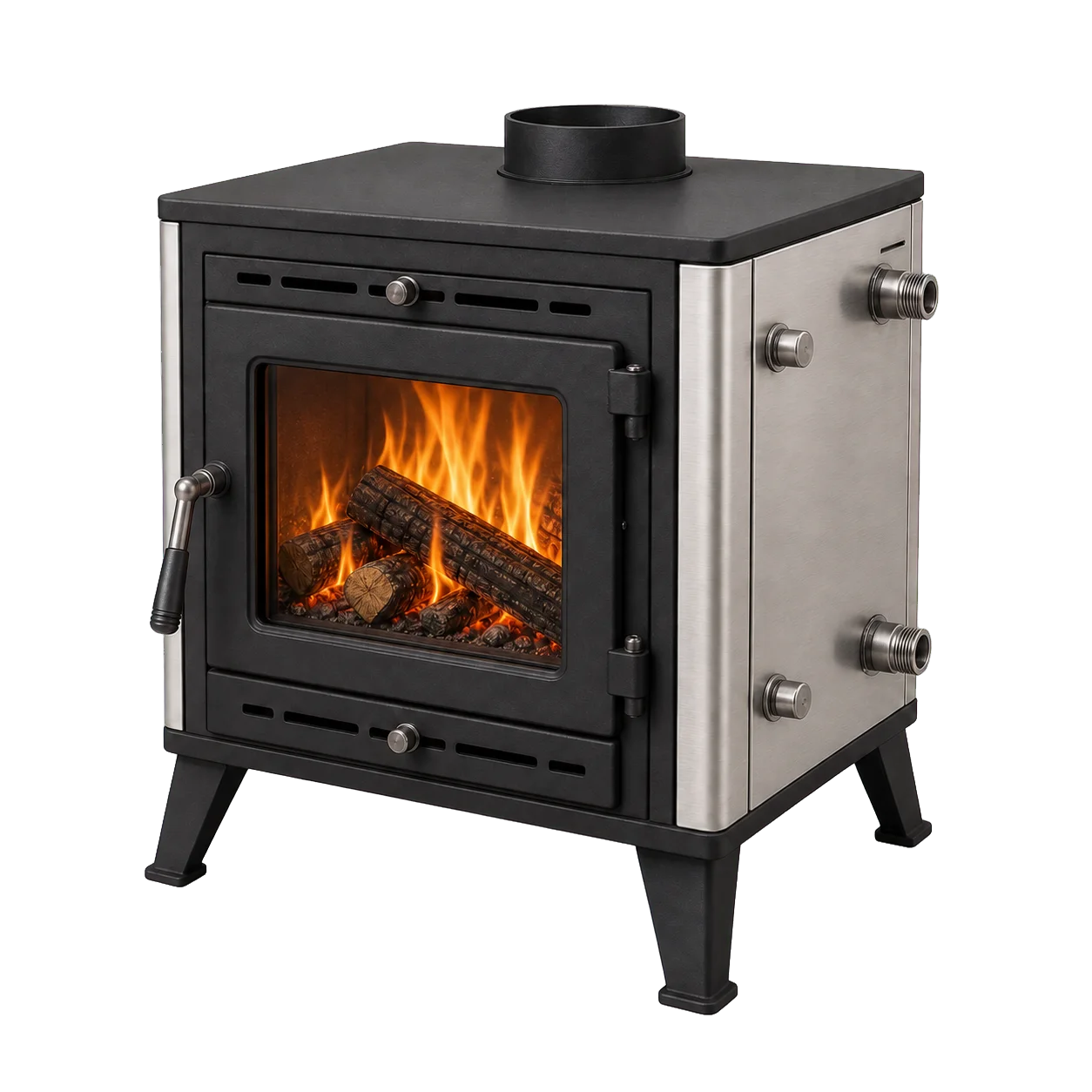
These water-jacket wood stoves combine a documented fire-side body with declared water-side materials and connections for professionally designed heating circuits.
Product Focus
A water-heating surface cannot be selected independently from the circuit it serves. Open, vented or other engineered arrangement, water quality, connection size, heat demand, safeguards and installation responsibility must be defined for each project.
The project identifies whether the intended arrangement is open, vented or otherwise professionally engineered; no universal pressure suitability is implied.
The jacket, fittings, stove shell and firebox face different corrosion, heat and fabrication duties.
Expansion, circulation, temperature control and dry-operation protection belong to the complete installation design with responsibility assigned to the qualified system designer.
Design Details
Fire-side contact, water containment, circuit connections and service access require a project-specific definition.
Jacket position and surface area are selected for the documented stove and system rather than presented as a universal output value.
Material, seams, fittings and intended pressure condition are specified for the exact configuration.
Inlet, outlet and drain positions are plotted against the planned circuit, installation access and documented service procedure.
The complete design assigns responsibility for circulation, expansion, temperature limits, dry-operation protection and required protective devices.
Specifications
The system schematic, operating condition, water quality, connections, heat demand and installation standard must be defined before model selection.
Materials & Finish
Heat exposure, water chemistry and fabrication method determine the component schedule.
The stove shell and firebox use model-specific steel construction independent of the water-side material claim.
Jacket grade, thickness, seam method and fittings are selected for the documented circuit and water conditions.
Fittings and sealing methods follow the system duty, while the external black or dark-grey finish remains outside the water-contact declaration.
Applications
The format belongs in projects with a defined hydraulic and installation plan, not in generic plug-and-play heating applications.
A documented circuit may combine stove heat with water distribution where freeze protection, expansion and qualified installation are addressed.
Workshop projects can consider water distribution only after heat demand, circuit routing, safeguards and local installation requirements are established.
Any potable or service-water claim depends on water-contact materials, system design, temperature control and destination requirements.
OEM & Private Label
OEM development begins with the system schematic rather than a request for a larger tank or additional fittings.
FAQ
Circuit type, safeguards, water-side materials and qualified installation must be established before output or connection options are discussed.
Not by default. Pressure suitability requires an explicitly designed, documented and verified configuration with appropriate safeguards.
Only a system designed for that purpose, with suitable water-contact materials, temperature control and destination compliance, should make that claim.
Provide circuit type, volume, flow, operating temperature, pressure condition, water quality, connections and required protective devices.
The system designer must define expansion, temperature control and fail-safe provisions for the selected circuit before the stove is specified.
A larger surface changes the thermal and hydraulic system. It requires complete project assessment rather than a dimensional change alone.
Provide the circuit type, water volume, flow, operating temperature and pressure condition, water quality, connection sizes, required safeguards and applicable destination standards.