Complete-Kit Weight Is the Relevant Claim
Body, legs, collar, pipe, damper, terminal, supports, hardware and pouch are included in the published carried figure.
Wholesale Tent Stoves
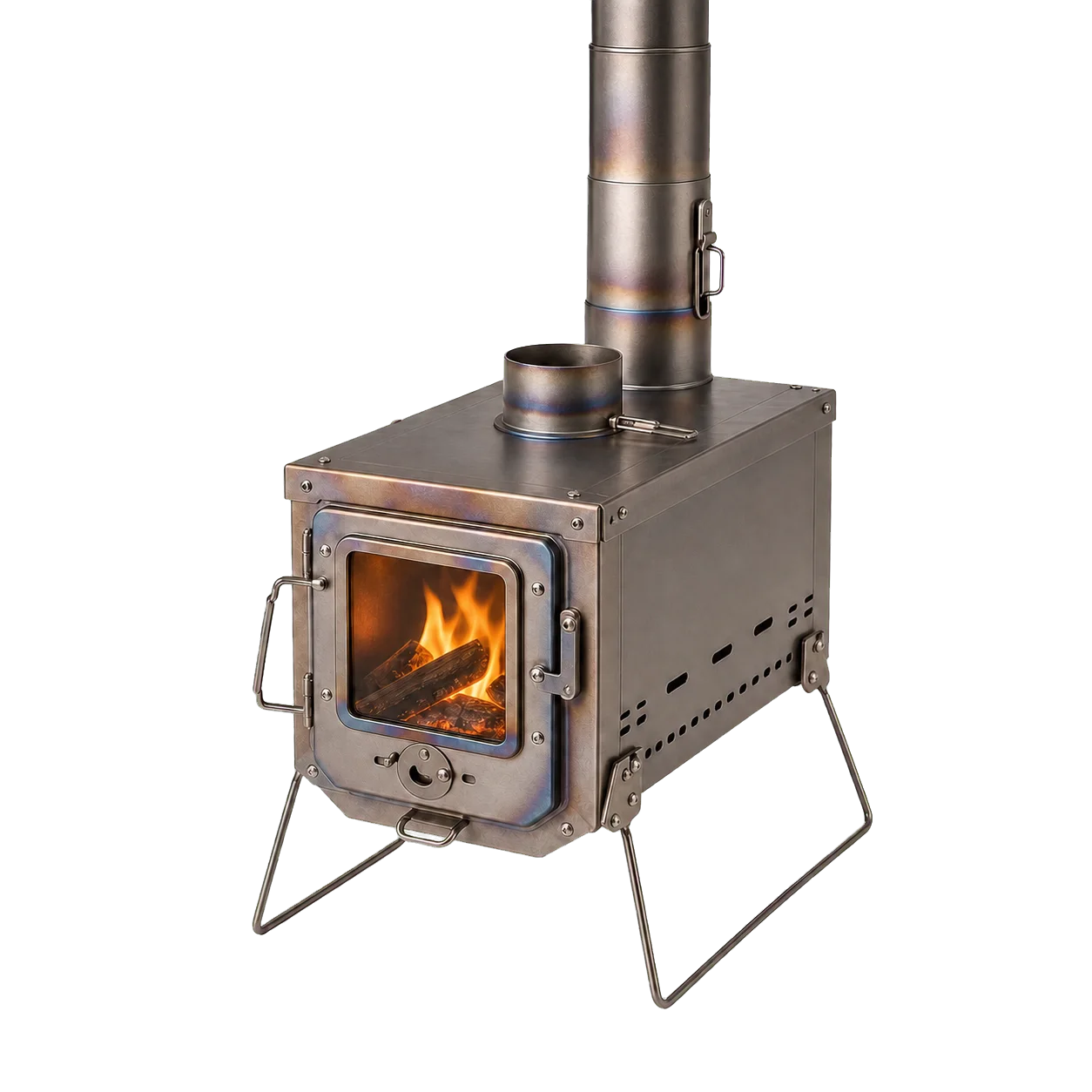
These titanium tent stove kits combine a stated complete weight, formed thin-panel construction, a matched roll or sectional flue and protective field storage.
Product Focus
Titanium can lower the carried weight of a tent-stove package, yet the body must still support the door, cookware and chimney after repeated heating. Buyers should compare the complete kit, not a bare shell, and understand that thin panels may change shape or color during normal use.
Body, legs, collar, pipe, damper, terminal, supports, hardware and pouch are included in the published carried figure.
Bends, returns and local reinforcement support load-bearing interfaces while limiting additional mass.
The pack controls sharp sheet edges, keeps chimney components in sequence and keeps critical hardware accounted for in remote conditions.
Design Details
Titanium reduces carried mass, yet thin panels move more visibly under heat. The design allows for expansion, protects roll-pipe edges and keeps doors, collars and supports aligned through repeated packing cycles.
Sheet grade, thickness and reinforcement are allocated around the top, door and leg interfaces.
Hinge, latch and frame geometry preserve usable closure without relying on the flexible skin alone.
Roll-up or sectional pipe is specified with known diameter, length, seam direction and support requirements.
Panel and pipe protection account for normal heat discoloration, residue and small-part organization after full cooling.
Specifications
Body weight, complete-kit weight, folded dimensions, sheet thickness and flue format belong in one specification, so weight-conscious buyers can see where mass was removed and how the remaining components are protected during winter travel.
Materials & Finish
Titanium body sheet, roll-pipe material and reinforced hardware perform different jobs. The material schedule should identify the declared grade, thickness and component function rather than use titanium as a blanket marketing claim.
Grade and thickness are stated for the firebox rather than relying on the word titanium as a complete durability claim.
Pipe material and format are declared independently because roll-flue setup and handling differ from the rigid body.
Fasteners, hinges or reinforcement may use other selected materials where their expansion, corrosion and service roles are understood.
Applications
Titanium models suit backpacking, winter hiking and ultralight hot-tent travel where customers measure every component against distance and terrain.
Low complete-kit mass supports human-powered winter travel where customers accept short fuel and active tending.
Compact body and pipe storage suit winter routes that still provide a compatible shelter and complete installation kit.
Documented component inventories, inspection points and spare-part references support operators managing low-mass equipment on supervised winter trips.
OEM & Private Label
Private-label development can coordinate complete-kit weight, panel format, roll-pipe system, reinforcement and protective storage for the intended winter journey.
FAQ
A useful comparison covers total carried weight, heat deformation, assembly method, flue handling and replacement-part planning—not material name alone.
It can reduce body and pipe mass, but the final comparison must include every support, control and storage component required to operate the stove.
Thermal movement and discoloration are normal possibilities. The design should retain functional assembly, door operation and flue support within stated condition limits.
Titanium offers strong corrosion resistance in many environments, but material choice also depends on heat duty, fabrication, weight, cost and component compatibility.
Compact titanium bodies often use short split wood. Practical fuel length should be stated for the selected firebox rather than assumed from the material.
Titanium packaging does not replace safe installation practice. The same compatible-shelter route, supported flue, CO alarm and active supervision apply to each intended deployment.