Filled Weight Governs the Mount
Tank capacity is translated into operating water mass and added to the vessel, bracket and stove loads before support geometry is fixed.
Wholesale Tent Stoves
These stove-and-tank packages combine declared water-contact materials, accounted filled weight, protected taps and removable cleaning access for compatible hot tents.
Product Focus
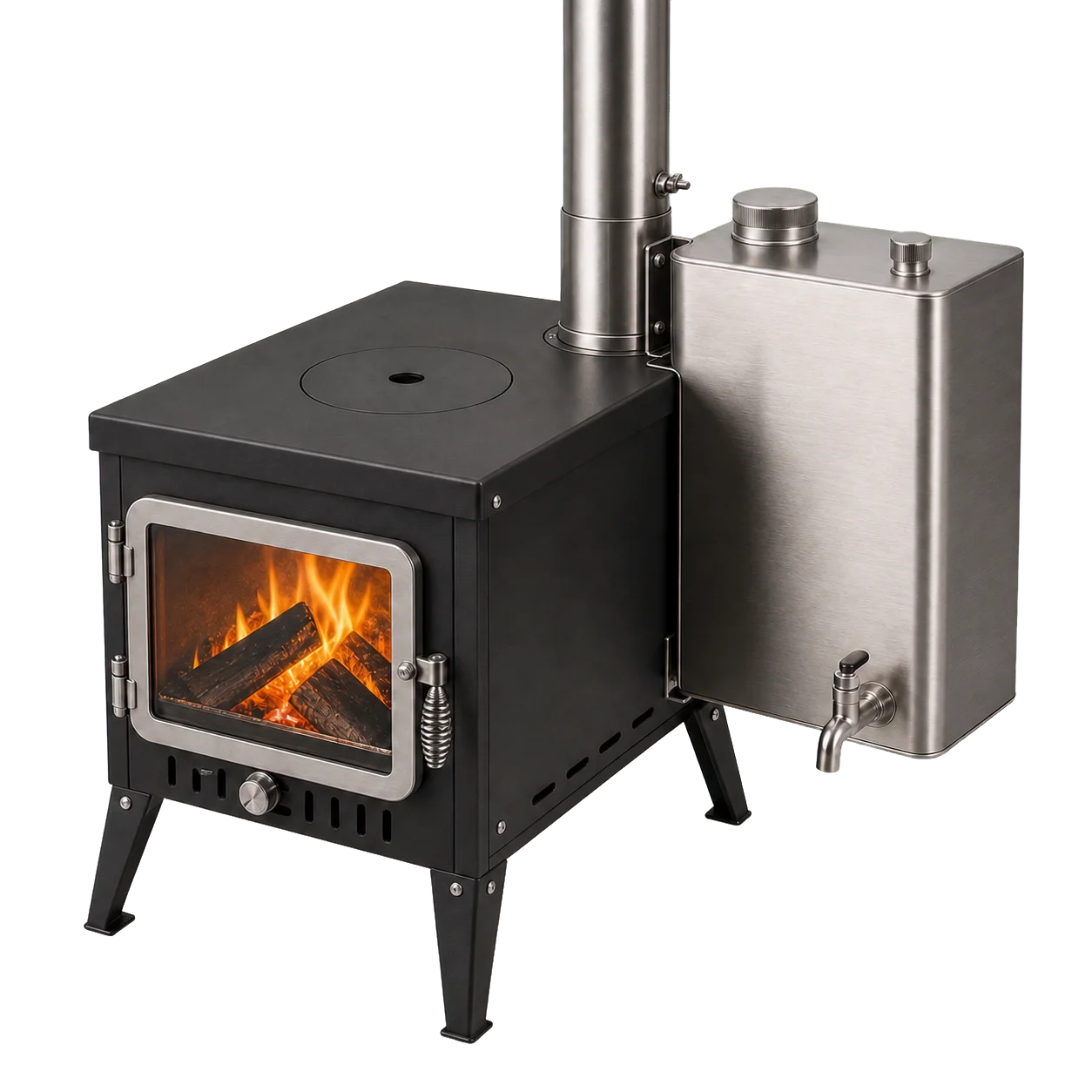
A side or rear tank can warm water during supervised stove operation, but it changes weight distribution and the way users work around hot surfaces. Capacity, support, venting, refill access and tap protection must be specified with the firebox and chimney. The tank must never be heated empty or sealed against pressure.
Tank capacity is translated into operating water mass and added to the vessel, bracket and stove loads before support geometry is fixed.
Tank shell, lid, tap and internal fittings are specified for water contact independently from the stove-body material.
Handles, clearance and connection details allow the cooled tank to be detached and serviced without disturbing the installed flue or bending supports.
Design Details
A water tank changes weight distribution, heat transfer and the way customers work around the stove. Tank support, tap clearance, refill access and dry-fire warnings must be integrated with the heating function.
Tank position receives heat without obstructing the firebox controls, collar or required air path.
Support geometry accounts for water mass, handle forces and repeated removal rather than only the empty vessel.
Lid and fill arrangement keep the specified vent path unobstructed during heating so the tank is not presented as a sealed pressure vessel.
Spout position and protection allow controlled dispensing while instructions address hot water, steam and surface hazards.
Specifications
Tank capacity, mounting position, empty and filled weight, tap geometry and removal method belong beside the firebox and pipe kit, so buyers can understand the added operating load and the complete water-handling workflow.
Materials & Finish
The tank, tap and wetted fittings require a clear stainless specification, while the stove body may follow a separate material strategy. Interfaces must tolerate repeated removal and heating.
Tank shell and wetted surfaces use a stated stainless grade with fabrication and cleaning guidance appropriate to water contact.
Valve, fittings and seals are declared for the intended temperature and water use, with replacement references where practical.
The firebox may use stainless or carbon steel under its own heat, finish and corrosion specification.
Applications
Water-tank models fit hot tents and basecamps where users need warm washing water or simple kitchen support without carrying a separate heating appliance.
Warm service water can support supervised washing and cleaning where the complete stove system is already installed. Potable-water use requires separately verified materials and destination requirements.
Operators can control filling, vent inspection, tap handling and cooled cleaning alongside normal flue and CO procedures.
Model-specific tanks can provide supervised service water for food-preparation cleanup and equipment washing, with potable use claimed only after separate material and destination-market verification.
OEM & Private Label
Tank capacity, mounting side, handle position, tap protection, packaging and operating guidance are coordinated with the stove model and the target market's camp-kitchen routine.
FAQ
Usable volume, filled mass, mounting security, wetted materials and cleaning access define a practical tank system.
No. Instructions should prohibit dry heating and require water level and an unobstructed vent path according to the model.
Water adds approximately one kilogram per liter, so support, stability and handling cannot be judged from empty tank weight alone.
It must not become a pressurized vessel. The specified vent path must remain open during heating.
It may preserve more of the top than a top-mounted vessel, but bracket and handle clearance can still affect cookware access and must be shown in the layout.
The mount, capacity, filled-load limit, stove-model compatibility, tap, seals, fittings and operating instructions must all match the identified stove revision.