Each Opening Needs Its Own Structural Support
Front and side or opposing windows are not assumed to share identical frame loads. Pane dimensions and reinforcement follow their location on the body.
Wholesale Tent Stoves
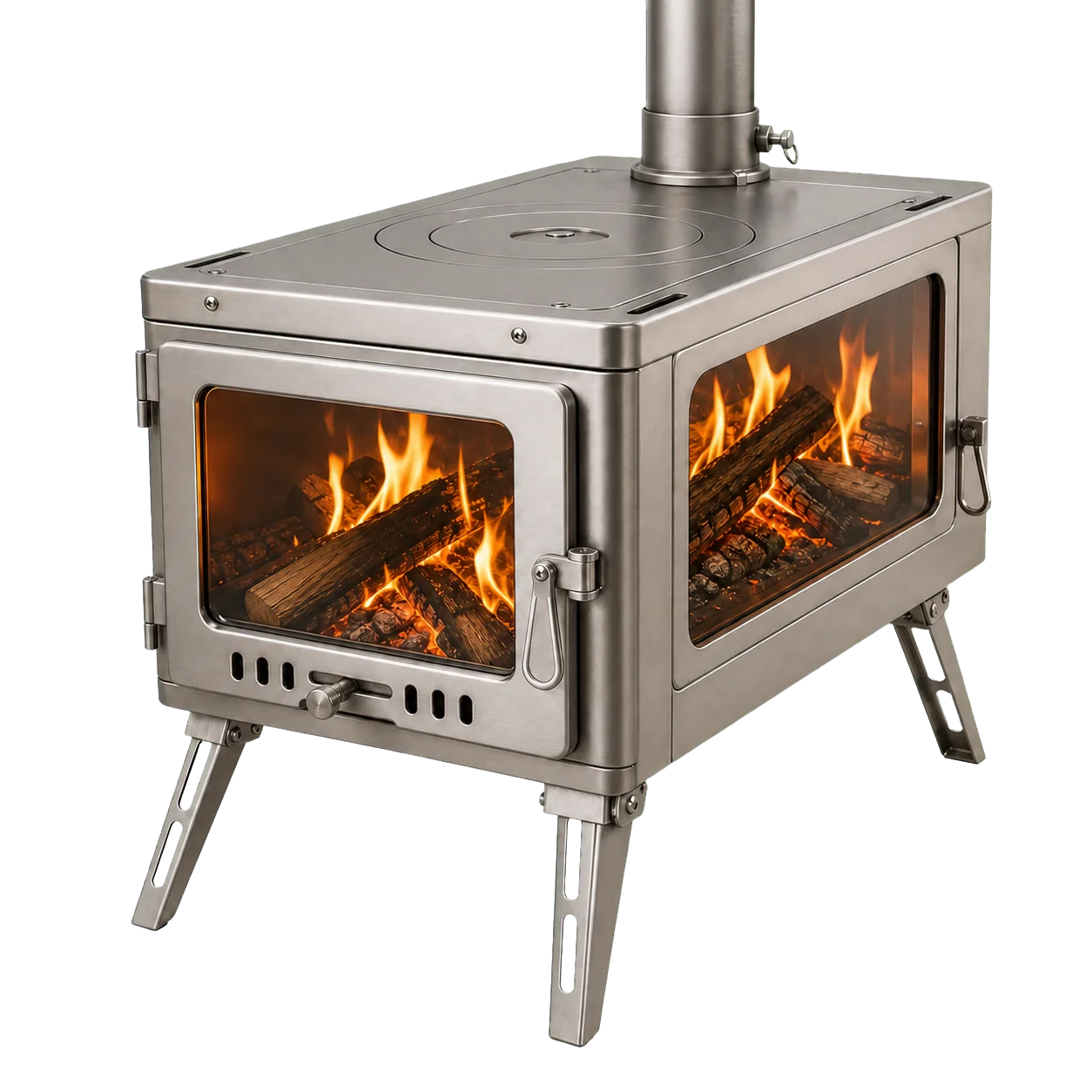
These dual-view tent stoves combine reinforced openings, independently serviceable glazing and a shelter layout that preserves operating access and clearances.
Product Focus
A second pane removes additional metal from the firebox and creates another hot viewing side. Frame reinforcement, gasket compression and replacement access must be resolved on both openings, while the installed stove position accounts for occupants approaching from more than one direction.
Front and side or opposing windows are not assumed to share identical frame loads. Pane dimensions and reinforcement follow their location on the body.
Glass, gaskets and retainers are coded by opening where dimensions or hardware differ, avoiding ambiguous after-sales replacements.
Seating, fuel loading and circulation are considered with the additional viewing surface rather than placing the stove as if only the door side were active.
Design Details
Dual glazing provides two flame sightlines, but it removes metal from two firebox surfaces. Frame reinforcement, seal compression and controlled airflow must account for both openings without weakening the stove body.
Hinge, latch, gasket and air settings remain serviceable around the main fuel-opening window.
Formed returns or supports restore stiffness removed by the additional pane.
Each seal and retainer system accommodates expansion without uneven clamping or improvised substitution.
Collar and pipe support are positioned so chimney loads do not distort either window frame.
Specifications
Document each panel size, glass specification, gasket route and replacement sequence. The firebox and chimney specification must then account for the larger glazed area and its use in occupied gathering spaces.
Materials & Finish
Titanium and stainless body options require different reinforcement and attachment details around the two windows. Exposed hinges, latches and frames need consistent fit and finish because both viewing faces remain visible in use.
Each pane carries its own type, dimensions, edge condition and service reference where the openings differ.
Stainless or carbon steel around both windows is allocated for hinge, latch, flue and panel loads.
Gaskets, clips and fasteners are documented by front, side or opposing opening rather than treated as universal parts.
Applications
These stoves suit compatible hot tents and managed glamping accommodation whose floor plans can use two viewing angles while preserving clearances, operator access and circulation around both hot faces.
Two viewing directions may suit compatible shelters where seating and fuel tending remain outside all stated hot zones.
Operators can use the added sightline where installation, inspection, spare glass and cleaning are controlled.
Front-and-side viewing can serve larger compatible shelters when the floor plan preserves the stated clearances, operator access and circulation around both hot faces.
OEM & Private Label
Glass proportion, frame geometry, door hardware, finish, spare-part identification and protective packaging can be specified as one serviceable dual-window system.
FAQ
Structural reinforcement, seal condition, cleaning access and position-specific replacement parts define the two-window system.
It removes structural sheet area, so frame design and local reinforcement must account for panel, door and chimney loads.
Only if their dimensions, edge finish and retainers are intentionally identical. Otherwise each opening needs a separate service reference.
Not necessarily. Airflow, fuel position and surface temperature can differ by side, affecting soot patterns.
The operating plan must preserve clearances and circulation around both hot viewing faces while keeping fuel loading accessible.
Yes. Door controls, a supported flue, floor protection, ventilation, CO monitoring, inspection and continuous supervision remain required; the second viewing panel adds clearance and service checks rather than replacing them.