Terminal Collar and Retention
Actual mating dimensions, wall construction, insertion or seating geometry, lock and cap interaction are recorded for the named pipe family.
Wholesale Stove Accessories
Each arrestor is specified as a serviceable terminal component in a named chimney system, with interface, screen geometry, open area, maintenance condition and claim limits stated together.
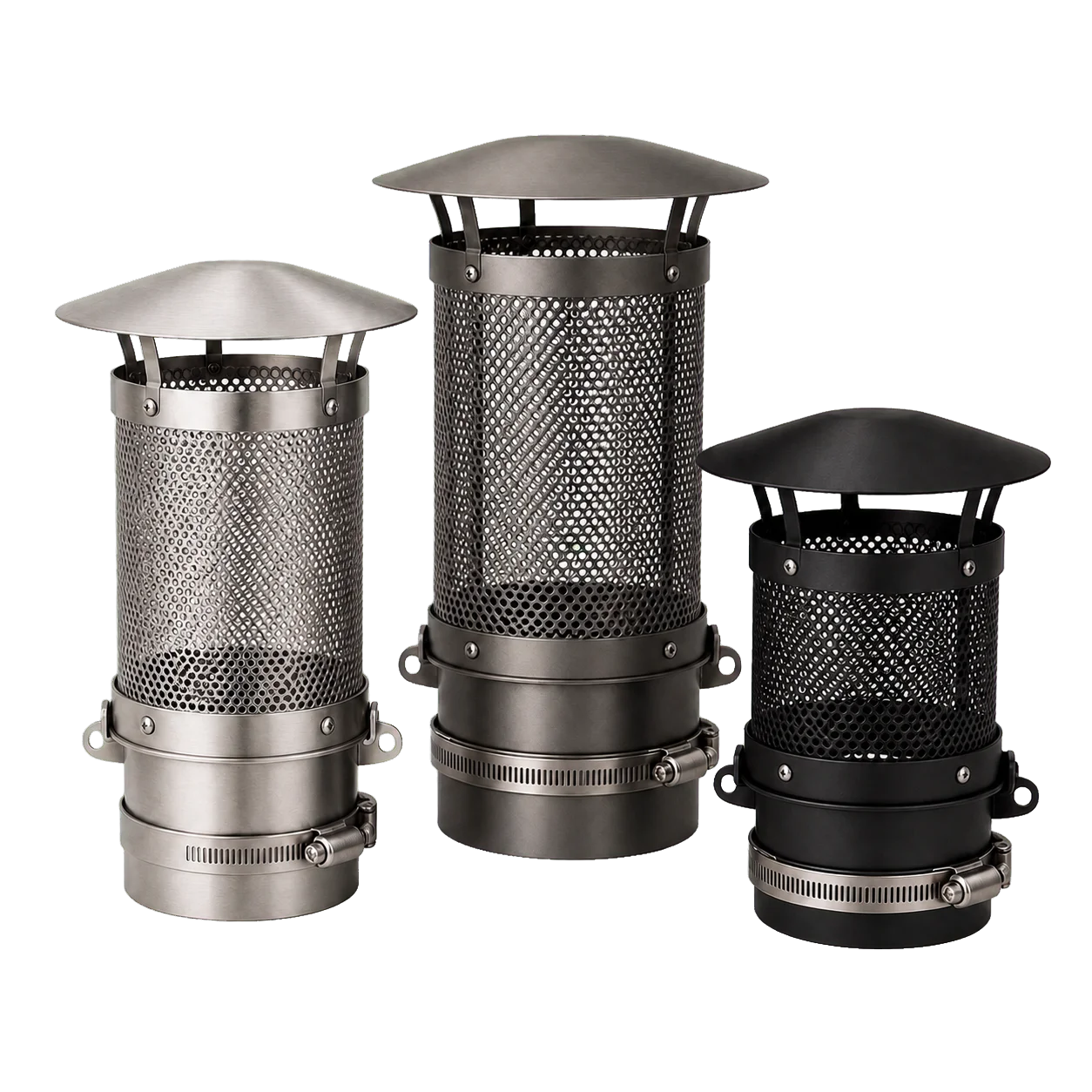
Product Focus
Reducing aperture can intercept different particles, but it also increases the surface available for soot accumulation and possible flow restriction. Selection therefore uses the applicable terminal requirement, complete screen geometry, named fuel and chimney, and an inspection state rather than assuming that finer mesh is universally safer.
Actual mating dimensions, wall construction, insertion or seating geometry, lock and cap interaction are recorded for the named pipe family.
Mesh material and grade, wire diameter, opening dimensions, gross screen area, overlaps and blocked frame areas support the net-area calculation.
Inspection interval, blockage indicators, access, removal, cooled cleaning and replacement are documented with the fuel and operating context.
Design Details
The arrestor is specified at the end of the complete named flue route in both clean and defined inspection conditions.
Collar seating, overlap, lock, cap orientation and removal action are checked against the controlled terminal interface.
Wire, aperture, seam, overlap, frame blockage and exposed geometry are recorded without converting nominal mesh into an automatic flow claim.
The named stove, fuel, chimney route, terminal, wind and weather condition are considered with the screen clean and at the stated inspection threshold.
The installed route provides safe access after shutdown and complete cooling, with blockage signs, cleaning method and model-specific replacement reference stated.
Specifications
The specification connects the applicable terminal requirement to one pipe family, complete screen, fuel and inspection routine.
Materials & Finish
Mesh, collar or cap, and locks or fasteners receive separate grade, temperature, soot and weather records.
Grade, wire diameter, aperture, weave or weld construction, seam, heat and weather exposure, cleaning method and replacement criteria are stated.
Grade, thickness, seams, drainage or outlet geometry, mating interface and exposure condition are documented without implying universal rain protection.
Steel grade, coating location and temperature limit, attachment, corrosion-care and replacement reference are declared without generic low-cost positioning.
Applications
The arrestor is relevant only where terminal fit, complete-system impact, inspection access and destination requirements can be documented.
A lightweight arrestor is limited to the named flue family, terminal interface, fuel routine, supervised shelter use and frequent cooled inspection.
A model-specific terminal can be specified around the complete chimney, local fire rules, operating fuel, wind exposure and accessible cleaning plan.
A fixed route requires the appropriate terminal duty, structural and cleaning access, inspection responsibility and applicable building requirements.
OEM & Private Label
OEM scope should align terminal duty, screen geometry, inspection route and replacement parts with the nominated chimney family and conditions.
FAQ
Terminal compatibility and maintenance requirements are specified around the complete named flue system rather than mesh size alone.
No absolute or universal containment claim is supported. Fuel, appliance operation, screen geometry, terminal conditions and maintenance state all influence emitted particles.
Aperture, wire area and soot accumulation can reduce net outlet area. Any impact is specified on the complete named chimney at the stated maintenance condition.
The product instructions link visual checking and cooled cleaning to the fuel, operating pattern and blockage indicators; a generic fixed interval is not substituted for those conditions.
No. Actual collar, wall construction, seating or overlap, lock and cap geometry can differ within the same nominal size.
The record identifies material grade, wire diameter, aperture shape and dimensions, construction, seams, net open area and applicable destination requirement.
The development record includes chimney and terminal family, mating interface, mesh requirement, fuel, complete-system condition, weather exposure, service access, quantity and destination.