One Hazard Definition before Geometry
The brief locates the radiant exposure or contact route, the people or surfaces involved and the applicable installation boundary before panel size, rail spacing or finish is selected.
Wholesale Stove Accessories
Each accessory is defined either as a spaced radiant shield, a stable contact boundary or a documented combination, with its host geometry, mounting reactions, open-air route and protected access stated separately.
Product Focus
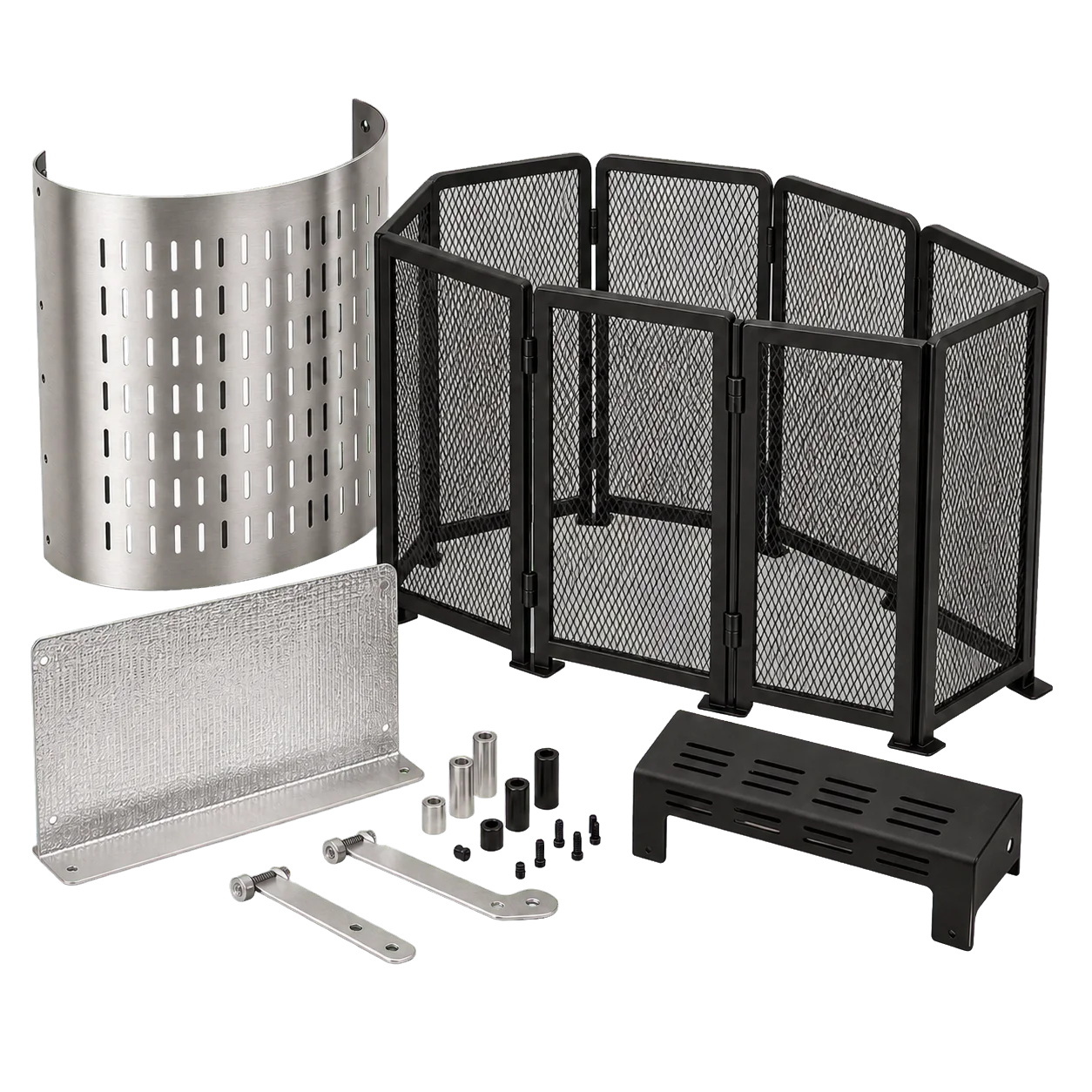
A shield changes radiant transfer through a controlled panel, spacing and airflow arrangement; a guard establishes a physical boundary around a hot appliance. The product record identifies which function is supplied and does not extend its claim to sparks, clearances or surface temperatures without evidence for the exact installation.
The brief locates the radiant exposure or contact route, the people or surfaces involved and the applicable installation boundary before panel size, rail spacing or finish is selected.
Brackets, spacers or freestanding feet maintain the recorded distance, open edges and stability without transferring an unverified load into thin appliance panels.
Fuel loading, air controls, ash removal, flue inspection and emergency access are demonstrated with the shield or guard in its installed position.
Design Details
Four coordinated details distinguish a functional protection accessory from a decorative metal surround.
Appliance revision, hot zone, nearby surface or user route, doors, controls and flue service points are located on the same installation drawing.
Attachment points and reactions are assigned to suitable host structure or an independent base, with stability checked in the intended operating area.
Panel gap and open edges are fixed for a radiant shield, while height, rail or mesh openings and stand-off define a contact guard without creating a storage shelf.
The installed accessory preserves fuel and ash handling, control travel, inspection, cleaning and removal paths throughout the documented service routine.
Specifications
The commercial specification connects one named hazard to the exact appliance, support method, functional geometry and evidence applicable to the assembled installation.
Materials & Finish
Heat exposure, structural contact and support reactions are assigned to individual components rather than implied by one generic material name.
Material grade, thickness, surface condition, perforation if present, formed edges and temperature or corrosion exposure are recorded for the selected shield panel.
Frame section, mesh or rail opening, joints, edge treatment, finish limits and intended contact duty are documented without treating the guard as a load-bearing shelf.
Material, section, fasteners, heat path, host contact, reactions, stability and model-specific replacement references are stated for the complete mounting set.
Applications
The relevant configuration follows the actual hazard, appliance revision, mounting surface, operator route and controlling installation requirements.
A lightweight guard can separate normal occupant movement from a named stove while preserving ventilation, a working CO alarm, all clearances, stove-jack relationships and constant supervision.
A spaced panel can be specified between a specific stove and nearby surface with defined mounting, airflow, measurement points and building-installation requirements.
A stable freestanding boundary can guide guest circulation while keeping doors, controls and service routes accessible; it does not reduce appliance clearances or permit unattended operation.
OEM & Private Label
Private-label development can coordinate panels, gaps, mounts and access from the appliance and installation.
FAQ
Function, installation and evidence should be defined before a protection or clearance statement is attached to the accessory.
No. A guard establishes a physical user boundary, while a shield uses a documented panel, spacing and airflow configuration to address radiant exposure. A combined product must substantiate both functions.
Not automatically. Any reduction must be supported for the exact appliance, shield construction, mounting, air gap and installation under the applicable requirements.
Only where the model-specific design and evidence define direct contact. A spaced shield depends on maintaining its stated gap, edge openings and mounting relationship.
Only after each appliance's hot-zone geometry, doors, controls, flue service, required offsets and the guard's stability remain within the documented configuration.
The final arrangement preserves fuel loading, air-control travel, ash removal, flue inspection, cleaning, shutdown access and every required ventilation route.
Please provide the appliance model and drawing, identified hazard and user route, proposed mounting surface, required spacing, service envelope, evidence target, quantity, branding and destination market.