Actual Dimensions at Both Mating Ends
Inside and outside diameter, tolerance, crimp or socket geometry, insertion depth and locking features are recorded for each end.
Wholesale Stove Accessories
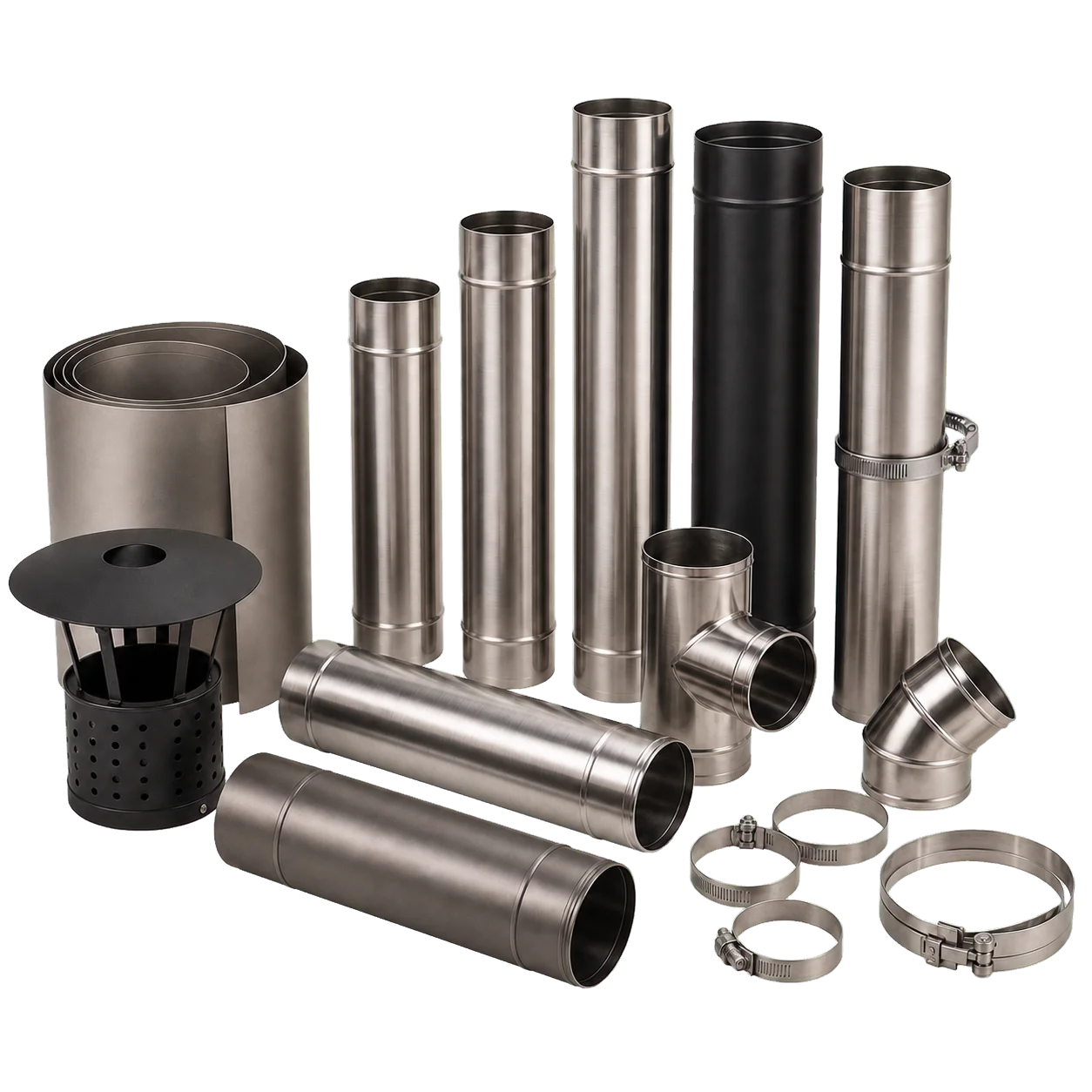
Each pipe section is identified as part of a named stove-and-chimney family, with its two mating ends, wall construction, installed orientation and duty recorded for the complete route.
Product Focus
Two sections carrying the same nominal size may differ in actual inside and outside diameter, crimp or socket depth, wall construction, lock and temperature classification. Selection therefore begins with the appliance, system family and installed route rather than a visual match or nominal bore.
Inside and outside diameter, tolerance, crimp or socket geometry, insertion depth and locking features are recorded for each end.
Single-wall, double-wall, rigid and roll-up formats carry separate inner and outer materials, thicknesses, classifications and installation limits.
Section orientation, supports, offsets, passage components, clearances and cleaning or removal access are documented within the complete system.
Design Details
The section is specified between the exact preceding and following components in its intended installed orientation.
Both ends are checked against controlled mating drawings or samples, including diameter, geometry, tolerance and insertion direction.
Overlap, stop position, clamp, ring, screw or other restraint is recorded without assuming that friction or nominal size secures the joint.
Length, wall type, vertical or offset orientation, external loads and the designated supports are specified in the complete route.
The route preserves access to joints and inner surfaces, with removal order and model or revision references stated for service.
Specifications
The specification links a controlled pipe revision to the named appliance, adjoining sections, route duty, support system and destination installation requirements.
Materials & Finish
Flue-facing material, any outer casing or insulation space, and restraints receive separate grade, thickness and temperature records.
Grade, wall thickness, seam or roll-up edge, surface condition, joint geometry, duty and storage care are stated for the exact section.
Steel grade, thickness, seam, coating location and temperature limits, soot-cleaning method and dry-storage requirements are documented for the named system.
Inner and outer materials and thicknesses, spacing or insulation, end closure, joint engagement and compatible system references are identified together.
Applications
The relevant section follows the appliance, pipe family, route position, wall duty, support and destination installation context.
A lightweight or roll-up section is limited to the named stove, adjoining pipe, stove-jack interface, support arrangement and supervised shelter instructions.
A rigid section requires documented system duty, structural supports, passages, terminal, inspection access and applicable building requirements.
A replacement program uses system, route position, mating-end drawing and revision references instead of treating nominal diameter as interchangeable.
OEM & Private Label
Private-label development can coordinate measured mating interfaces, wall construction, installed lengths, joints, markings and packing around a named stove-and-pipe family.
FAQ
Compatibility belongs to the named appliance and pipe family, actual mating interfaces, wall duty, installed route and support condition.
Not necessarily. Actual inside and outside dimensions, tolerance, crimp or socket geometry, insertion depth, wall construction and locking method can differ.
The controlled system drawing and appliance instructions define orientation and overlap; no single direction can be generalized across unrelated chimney families.
No generic substitution is supported. Wall construction, materials, temperature classification, clearances, supports and installation requirements belong to the complete named system.
The record includes appliance and pipe family, route position, both mating ends, insertion orientation and depth, lock, installed length, wall type, material and revision.
Packing is specified for the actual rigid, nesting or roll-up format, with mating ends, seams, thin walls, finishes and assembly order separately protected and identified.
The development record includes appliance collar, adjoining components, route position, actual interfaces, wall construction, material and duty, supports, markings, quantity and destination.