Support Geometry before Overall Size
The drawing records ledge or retainer location, contact length, orientation, surrounding clearance and insertion path so the grate seats consistently without bearing on unintended firebox surfaces.
Wholesale Stove Accessories
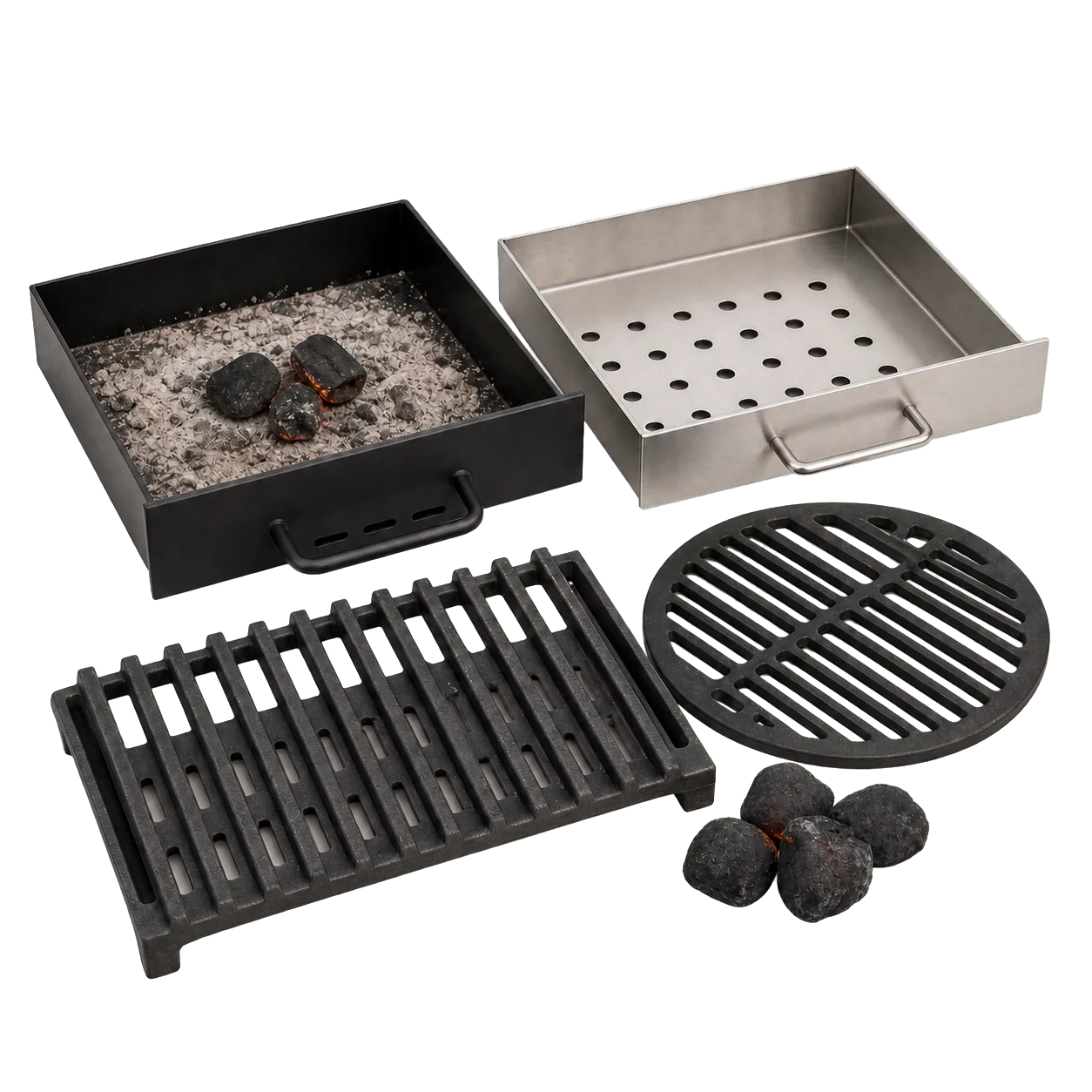
Each replacement part is tied to a named firebox revision: the grate registers on controlled supports and carries the specified fuel bed, while the pan preserves the under-grate air space and passes through the service opening after complete cooling.
Product Focus
Outside stove dimensions do not reveal ledge height, taper, retainers, air inlet position or the door opening available for removal. A reliable replacement record therefore separates grate support and fuel-bed requirements from pan capacity, handle clearance and the route used to extract cold residue.
The drawing records ledge or retainer location, contact length, orientation, surrounding clearance and insertion path so the grate seats consistently without bearing on unintended firebox surfaces.
Bar section, spacing or perforation pattern is selected for the documented wood or charcoal bed and its primary-air relationship, rather than copied from a visually similar grate.
Pan depth and fill limit retain the required space below the grate, while folded edges and handle geometry permit level removal through the actual opening once fuel and residue are fully cold.
Design Details
The grate and pan are specified as separate wear components within one controlled firebox section.
Outline, support contacts, retainers, insertion angle and thermal movement allowance are checked against the named firebox revision or an approved physical sample.
Bars or perforations carry the nominated fuel mass while maintaining the documented primary-air path and limiting pieces from dropping prematurely into the pan.
Usable ash depth, handle and folded edges remain clear of the grate, inlet and other internal features throughout the stated cleaning interval.
The cold pan and removable grate pass the door, lip and controls in the documented order without requiring residue to be tipped back into the firebox.
Specifications
A compatible part number connects the host revision to internal supports, fuel duty, clearances, material condition and the complete removal route.
Materials & Finish
Direct fuel exposure, cyclic heat, impact and cooled residue handling place different demands on the grate, pan and grip features.
Casting grade or specification, section, support faces, opening pattern, surface condition and dimensional tolerances are declared for the approved host and fuel bed.
Steel grade, bar or sheet section, perforation geometry, joints, support registration and heat-distortion acceptance are documented for the named fuel configuration.
Sheet grade and thickness, corners or seams, folded rim, usable depth, handle attachment, corrosion care and cold-removal direction are stated for the selected pan.
Applications
These replacement parts suit buyers who can identify the original firebox and its internal supports.
A controlled set restores the documented log support, primary-air relationship and cold ash route without assuming that another stove of similar width shares the same interior.
A replacement grate follows the original coal depth, vent relationship and food-grid clearance, with a pan sized for the stated cold-ash cleaning interval.
Removable fuel supports or residue pans are suitable only where the insert provides the recorded ledges, air route, thermal duty and level extraction access.
OEM & Private Label
OEM development starts with a controlled host drawing, original part or measured master sample and preserves separate records for the grate and pan.
FAQ
Part selection begins with the original host and internal interfaces; nominal appliance width and visual similarity are not reliable fit criteria.
Not necessarily. Ledge position, retainers, taper, air inlet, insertion angle and door opening can differ even when the external bodies are similar.
Please provide the firebox outline and depth, support contacts and height, retainers, surrounding clearances, door or service opening, insertion direction and original part reference where available.
Only when the host documentation supports the resulting fuel bed, primary-air path, grate load, clearances and thermal condition. A grate change alone does not establish a fuel conversion.
The fill limit must preserve the documented air space below the working grate and allow the pan to pass the opening level; total shell volume is therefore not the usable service capacity.
No. Fuel, internal components and residue must be fully extinguished and cold before inspection, removal or disposal under the appliance instructions.
Please provide the host model and revision, original drawing, part or measured sample, support and opening geometry, fuel and load condition, material target, quantity, branding and destination market.