Usable Vessel Positions
The layout distinguishes cookware contact areas from decorative edges, handles, removable rings and service clearances.
Wholesale Rocket Stoves
These cooktop rocket stoves are specified by usable vessel positions, filled cookware loads, observed heat roles and access for fuel tending and cooled service.
Product Focus
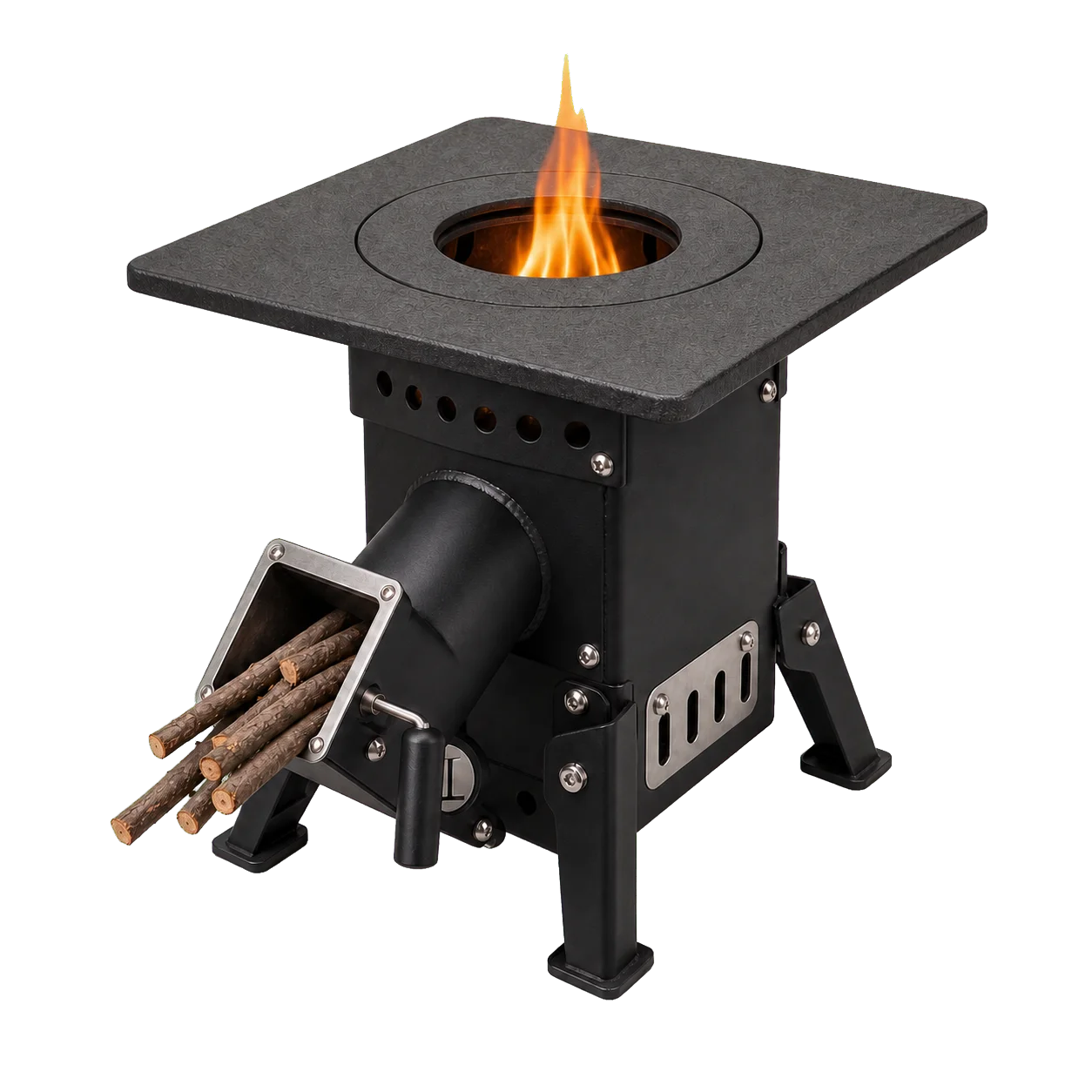
Overall plate dimensions do not establish usable cooking capacity. The selected model identifies cookware contact areas, simultaneous filled loads, observed temperature behavior and the access needed for fuel tending and cooled cleaning.
The layout distinguishes cookware contact areas from decorative edges, handles, removable rings and service clearances.
Top structure, body support and ground footing are checked with the nominated vessels in their intended positions.
The loaded-layout specification records operator reach to the fuel opening and access to removable parts and ash areas after cooling.
Design Details
Chamber position, top support, vessel layout and service access define the cooking system.
The chamber-to-plate relationship is documented without implying uniform temperature or a specific heat role across the surface.
The top, frame, body and footing are specified around nominated filled vessels rather than inferred from plate thickness alone.
The loaded-layout check records handle clearance, vessel interference and access to the fuel-tending route.
Declared food-contact surfaces, removable rings and residue areas receive separate material and cleaning instructions.
Specifications
Pot bases, filled loads, menu and fuel routine determine the working cooktop layout.
Materials & Finish
The structural shell, cookware-contact top and direct food-contact areas receive separate material declarations.
Steel grade, thickness, reinforcement, joint method and coating limits are stated for the selected chamber and cooktop load.
Casting grade, section, flatness, cookware-contact areas, seasoning and cleaning requirements are documented for the selected top.
Plate grade, thickness, finish and food-contact status are declared with material-specific preparation and care instructions.
Applications
The format suits supervised outdoor kitchens with nominated cookware, prepared fuel and documented vessel roles.
The selected layout can be specified against a planned meal sequence, simultaneous vessels and observed heat-zone behavior.
Regional pots, filled loads, fuel supply and the operator's normal tending route can define a farm cooking configuration.
This layout is checked against packed dimensions, cookware positions and side-feed access for a transport-ready configuration.
OEM & Private Label
OEM development can coordinate top geometry, rings, chamber and fuel access with the target menu.
FAQ
Usable vessel positions, simultaneous loads and observed heat behavior define the cooking capacity of a selected model.
No uniform temperature is assumed. Heat behavior depends on chamber position, plate construction, fuel, operating method and vessel placement.
The model record identifies supported vessel contact areas and excludes decorative edges, handle zones and required access clearances.
Cast iron, carbon steel and stainless steel offer different mass, seasoning and care. Selection follows the menu and ownership routine.
Only when both vessels, positions and filled loads fall within the simultaneous-load condition documented for the selected model.
No. A body coating does not establish food-contact suitability; only surfaces explicitly declared for direct food contact should be used that way.
Provide cookware bases and filled loads, simultaneous positions, menu, fuel, plate material, packed or installed size, quantity and destination.