Air-Path Design
Identify the primary inlet, fuel support, secondary passage and upper outlets.
Wholesale Rocket Stoves
Compare gasifier rocket stove configurations by their fuel specification, primary and secondary air paths, and operating method. Cooking, smoke and efficiency results must relate to the exact setup being considered.
Product Focus
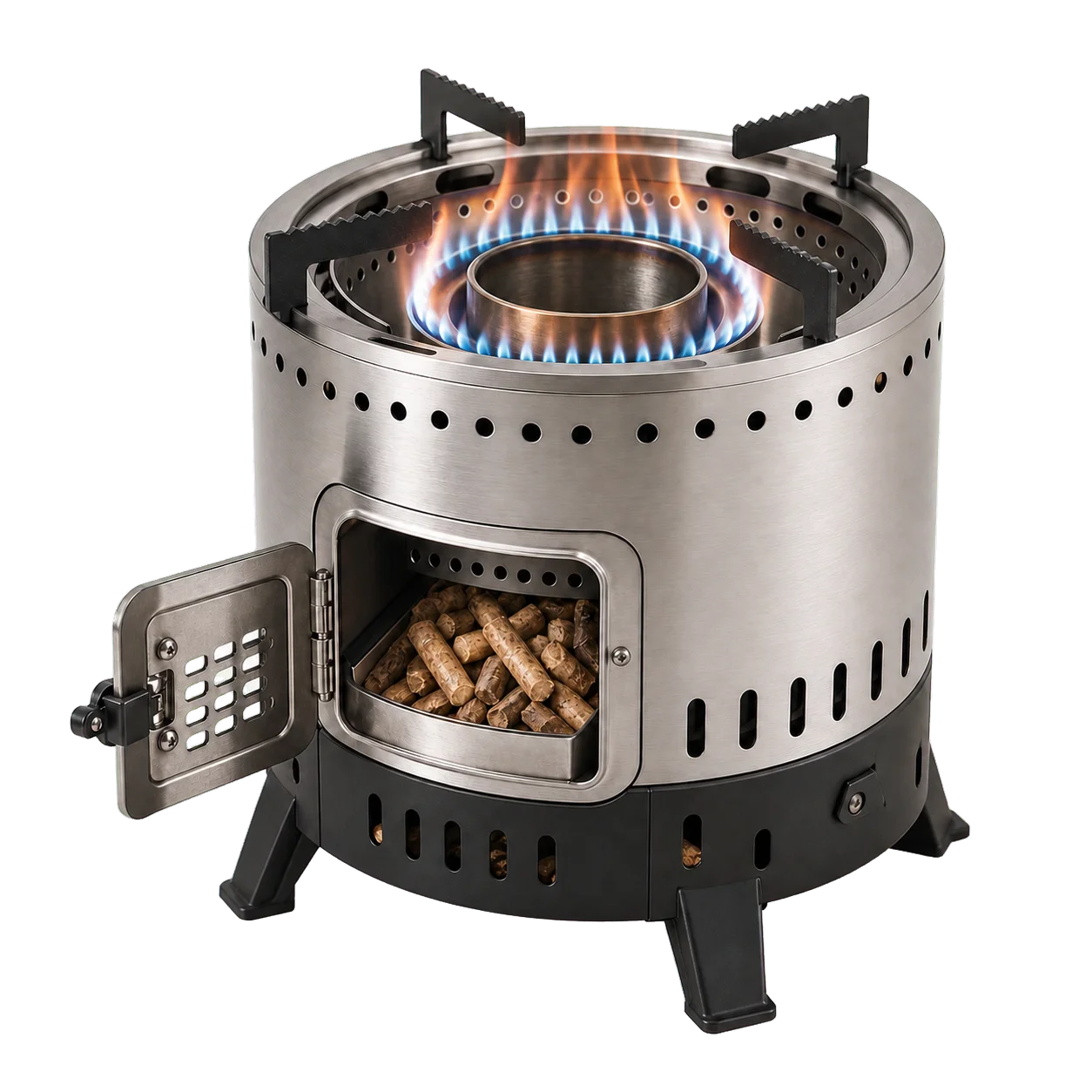
Gasifier stove designs use staged air delivery: primary air reaches the fuel bed, while secondary air mixes with combustible gases above it. The air passages, fuel preparation and loading method work together. Compare performance data for the exact configuration; a double wall or ring of holes alone does not establish gasification performance.
Identify the primary inlet, fuel support, secondary passage and upper outlets.
Agree fuel size, moisture, loading quantity, fill depth and lighting method.
Keep smoke, efficiency and residue results tied to the model, fuel, vessel and measurement conditions.
Design Details
Keep the loading method, air paths and shutdown procedure specific to the selected design.
Fuel quantity, particle size and fill depth establish the bed used by the staged-air system. Batch loading and supported refill arrangements differ, so the lighting and loading sequence must follow the exact design.
The primary inlet supplies air to the fuel bed through the selected support arrangement. Inlet position and grate geometry form part of the complete operating system rather than a separate performance guarantee.
A secondary passage routes air to outlets above the fuel area, where the design intends further combustion of released gases. Actual combustion, smoke and efficiency results are provided per model.
The operating cycle leaves residue whose form depends on the fuel and procedure. The model’s shutdown and cooled-removal method determines safe handling; appearance alone does not establish useful char yield.
Specifications
Compare the fuel load, air-path configuration, cookware and measurement conditions behind each result.
Materials & Finish
Assess hot-zone construction and service access as well as the material grade.
Confirm grade, thickness, perforation and joint construction for the hot-zone components.
Compare body grade, thickness, finish location and storage requirements.
Confirm model references for any replaceable fuel supports, char containers or ash parts.
Applications
Choose a configuration with a clear operating method and test data suited to the intended use.
For a supported batch-operated model, coordinate fuel preparation, cookware, ignition and shutdown.
Specify compatible stored fuel, complete parts and instructions for open-air use.
Use a fixed configuration and measurement method so comparisons remain meaningful.
OEM & Private Label
We can develop the chamber, air passages and cookware support around your fuel and evaluation requirements.
FAQ
Gasifier terminology describes a technical approach; performance is confirmed with test data for each model.
No. A double wall describes construction. A true gasifier uses an established staged-air design and operating method, backed by relevant test data.
We do not describe any stove as completely smokeless. Smoke comparisons are given with test data and clearly stated fuel, operating and measurement conditions.
Provide representative fuel material, particle size, moisture, density, loading weight, fill depth and preparation.
Only if the selected design explicitly supports it. Many gasifier formats are batch-based; follow the model’s loading and supervision instructions.
State the model, fuel, cookware, operating method, measurement basis and units. Do not transfer the result to other setups.
Provide representative fuel, loading conditions, air-path requirements, cookware, required test data, materials, quantity and destination.