Pot Base, Feet and Ring Contact
Compatibility is documented from the actual base diameter, foot spacing, body profile and support contact rather than nominal capacity.
Wholesale Oven Stoves
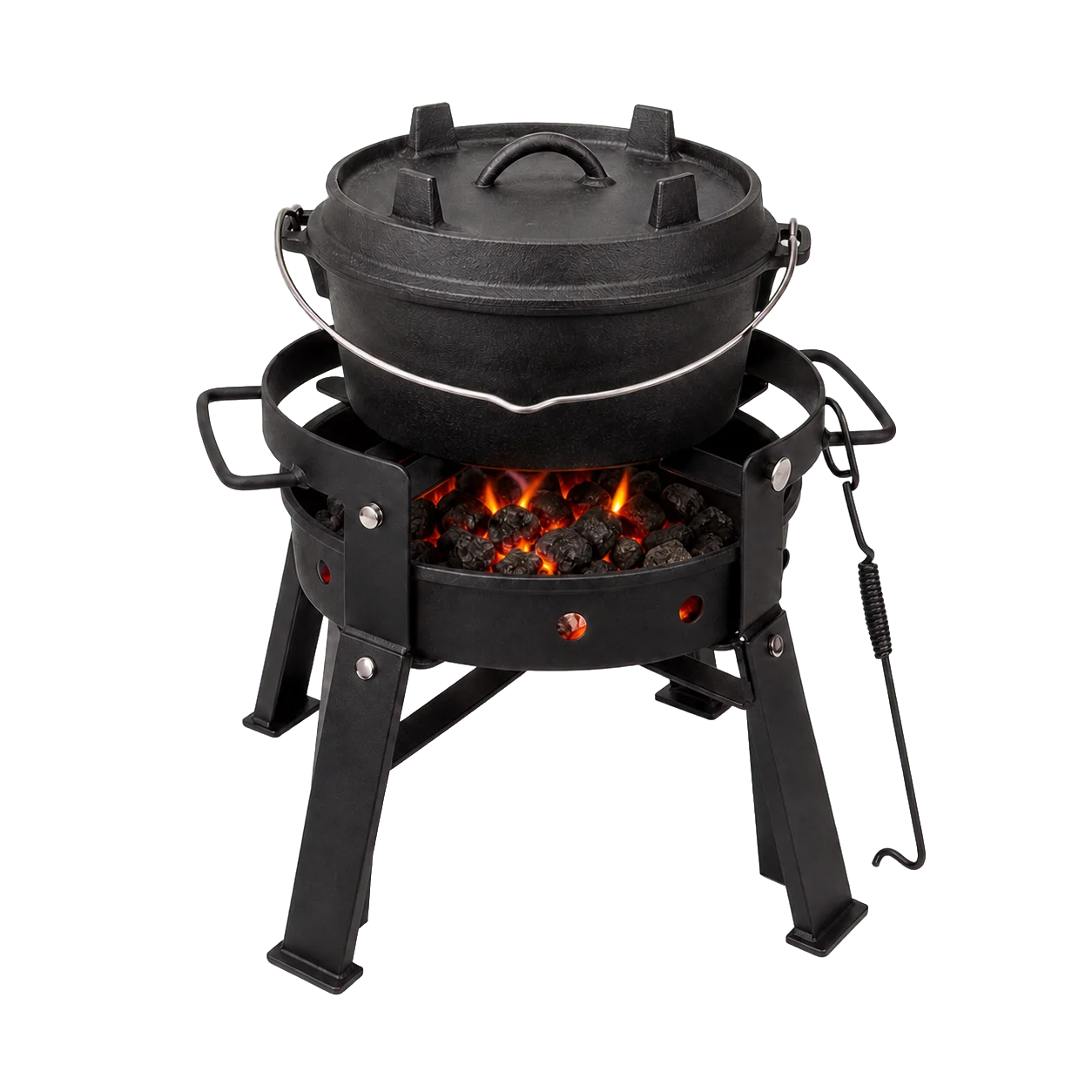
These Dutch oven stove sets are specified around a named cast-iron vessel, maximum filled mass, ring and footing geometry, coal placement and the required handling tools.
Product Focus
Quart capacity alone does not describe how a Dutch oven contacts a support or behaves when loaded. The selected set records pot base and feet, lid and bail geometry, full cooking mass, lower and upper coal method, ground condition and handling tools.
Compatibility is documented from the actual base diameter, foot spacing, body profile and support contact rather than nominal capacity.
Coal placement, adjustment tools and operator clearance are specified around the nominated filled vessel on the declared surface.
The component list identifies lifters, hooks, tongs or handles matched to the selected lid and cooking method.
Design Details
The set specification follows the filled vessel load through its support and footing while recording coal and tool access.
Contact points, movement and clearance are checked with the nominated pot base, feet and maximum filled mass.
Access and tool movement are recorded beneath the loaded vessel for the documented cooking method.
Ring, legs, braces and base movement are checked on the declared surface during lid lifting, stirring and serving.
Lifter engagement, bail clearance, upper-coal handling and hot-tool placement are checked for the selected cookware.
Specifications
Pot model, base geometry, filled mass, menu and handling tools determine the complete set.
Materials & Finish
Ring, legs, braces and tools receive separate structural, heat, grip and surface specifications.
Steel grade, ring and leg section, brace geometry, joints and finish are documented with the nominated filled-vessel load.
Where included, casting grade, section, contact geometry, inspection and replacement reference are stated for the selected vessel.
Tool material, section, handle length, engagement geometry and cooled-storage position are declared for the intended routine.
Applications
Each use case receives a named vessel, cooking method, ground condition, tool inventory and cooled-storage plan.
A complete set can be specified around the nominated Dutch oven, menu, maximum filled load, coal method, tools and vehicle storage.
Regional vessel geometry, longer meal routines, ground surface and local fuel can define a farm cooking configuration.
Instructor and participant movement, named cookware, support contact, tool count and hot-coal procedure can be documented for the course format.
OEM & Private Label
Private-label work begins with vessel geometry and filled load, then defines support, tools and storage.
FAQ
Vessel geometry, full cooking load, support surface and coal routine define compatibility for a selected set.
No. Base diameter, feet, body profile, lid and bail geometry and filled mass vary. Compatibility applies only to the documented vessel range.
The complete frame is checked on the intended surface with the nominated maximum filled vessel and the documented lifting, stirring and serving routine.
Only when the cookware and method support upper coals and the set includes suitable lid and coal tools with instructions.
The component list identifies any lid lifter, coal tongs, hooks or heat-resistant handles required by the declared method.
No. Coals must be fully extinguished and every component cooled and cleaned to the stated packing condition before storage.
Provide vessel model and dimensions, maximum filled load, lower and upper coal method, ground surface, tools, materials, case requirements, quantity and destination.