Destination Fuel Comes Before Basket Geometry
Pellet diameter, length range and expected quality are documented before perforation and capacity are fixed, reducing the risk of a basket designed around an unspecified factory fuel.
Wholesale Fire Pits
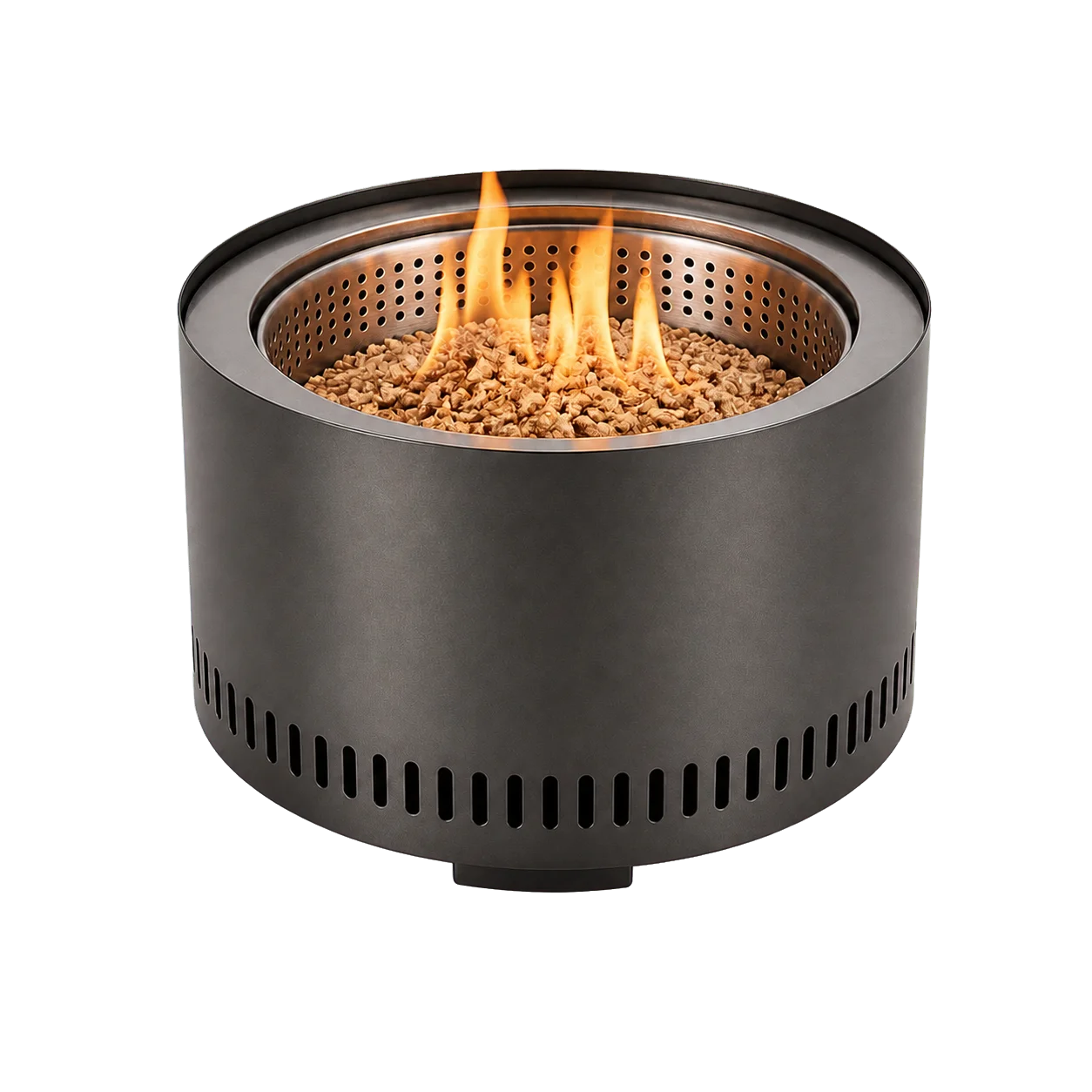
These pellet fire pits combine a defined basket, destination-market fuel dimensions and an air-and-ash system specified as one combustion arrangement.
Product Focus
Pellets offer consistent dimensions and compact storage, but combustion behavior still depends on basket perforation, fuel depth, air entry and clearance for ash. Basket geometry should follow the pellet dimensions, composition and moisture conditions found in the destination market. No low-smoke or burn-time claim is made without representative testing.
Pellet diameter, length range and expected quality are documented before perforation and capacity are fixed, reducing the risk of a basket designed around an unspecified factory fuel.
Openings must admit combustion air while giving cooled residue somewhere to collect. Basket removal and ash access are considered without requiring the user to overturn the complete product.
A model intended for both pellets and small wood needs a suitable support arrangement and customer instructions for each fuel. Compatibility is not inferred from chamber size alone.
Design Details
Basket perforation, pellet depth, primary air entry and ash clearance must work together with the pellet format sold in the destination market.
Capacity and perforation are matched to the nominated pellet dimensions rather than to a generic biomass label.
Openings below and around the basket support combustion while retaining the selected fuel and limiting loose spill.
Space beneath the basket allows residue to fall away from active pellets and remain accessible after full cooling.
Supports, wall geometry and handles are arranged around the hot basket without implying safe contact during or immediately after use.
Specifications
Basket geometry and declared pellet dimensions provide the basis for model selection without relying on a broad biomass-fuel description.
Materials & Finish
The perforated basket, support and outer shell carry different heat and corrosion duties, so their grades and finishes are stated independently.
A declared stainless grade can support the perforated heat-facing component and repeated cold cleaning.
The structural shell may use unpainted stainless or coated carbon steel, with heat exposure and outdoor care defined for the selected material.
Tray and support materials are selected for residue contact and are identified as service parts where replacement is practical.
Applications
The format suits customers who value portioned fuel and a defined basket, while still requiring outdoor-only operation, ash care and local fire-rule guidance.
Pellet models fit customers who can obtain the named fuel and value a defined fuel charge in managed outdoor settings.
Smaller models may suit stable outdoor tables when the specified base, surface protection, clearances and local open-flame rules are followed.
Portable formats may suit permitted campsites where pellets remain dry and the complete unit can cool before return transport.
OEM & Private Label
OEM decisions begin with the customer’s pellet diameter and composition, followed by basket size, air pattern, body format and operating instructions.
FAQ
Fuel compatibility and basket behavior determine whether flame appearance or burn-duration information can be supported for the selected pellet.
No. Diameter, length, composition, density and moisture vary. Compatibility should be tied to the pellet format used for development and customer guidance.
No. Visible smoke depends on fuel quality, ignition, airflow, loading and weather. No fixed low-smoke claim should be made without representative testing.
Not automatically. Small wood pieces may need different support, loading and air access. A separate insert or model can be more appropriate.
Fuel quality, excessive depth, blocked perforations, poor lower-air access or accumulated ash can all affect the burn pattern.
After complete extinguishing and cooling, the basket and ash component should be removable or accessible according to the model-specific instructions.