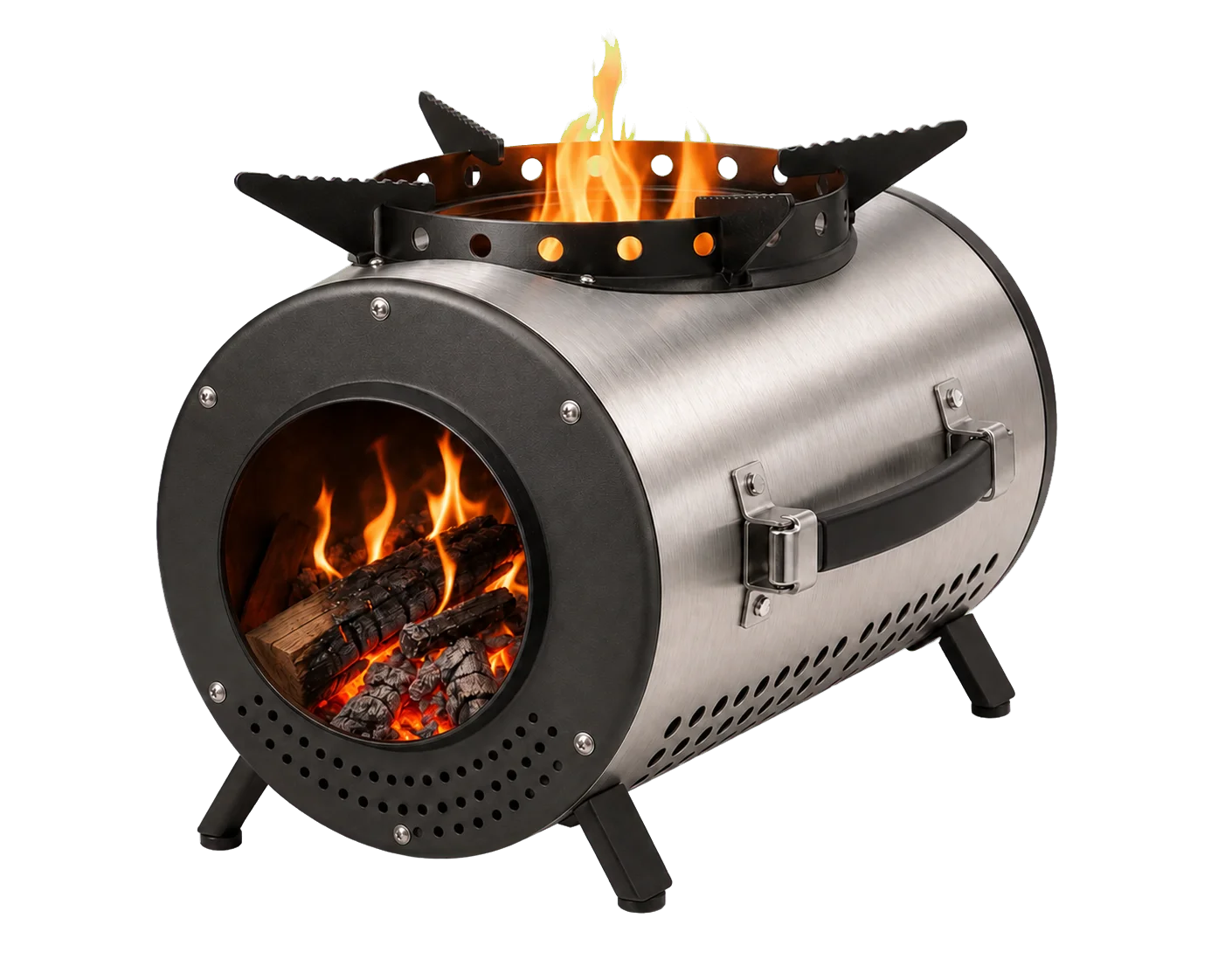
A Rounded Body with a Central Fuel Chamber
The cylindrical shell provides a central combustion chamber with fewer broad flat-panel spans and a compact vehicle-storage profile.
Wholesale Camping Stoves
These round-bodied camping stoves combine a rolled shell, centered pot support, defined anti-roll footing and accessible ash handling for vehicle-based outdoor cooking.
Product Focus
A cylindrical shell avoids broad flat side panels and creates a central combustion chamber. Shell seam, base, feed door and handles must be configured together and documented with the nominated cookware on the specified stable surface.
The cylindrical shell provides a central combustion chamber with fewer broad flat-panel spans and a compact vehicle-storage profile.
Leg spread, door force and cookware position should be checked together because a round body must remain settled while fuel is added or a pot is stirred.
Body diameter determines usable fuel length, top contact area and nesting possibilities. The intended vessel and stable outdoor surface should be confirmed before handles, base parts or ash components are selected.
Design Details
Vent distribution, grate height and top opening determine whether the circular format produces useful cooking heat rather than an attractive shell.
A rolled body gains geometric stiffness from its curvature, while longitudinal seams and openings are positioned away from the most heavily loaded zones.
Feed door, air control and rear closure are registered to the same axis, with joint fit and air-leakage limits stated for the selected model.
A formed top saddle or attached plate provides defined vessel contact instead of asking a pot to balance directly on a narrow curved surface.
On the specified stable surface, leg spacing and handle orientation address the side force applied at the feed door and reduce the risk of rolling or shifting under the nominated cooking load.
Specifications
Nominated cookware, fuel charge and loaded-stability criteria establish the body dimensions, while the base and handles determine transport and loading behavior.
Materials & Finish
Forming quality and coating coverage are especially visible around a continuous cylindrical wall.
A clean round body depends on controlled forming and a consistent longitudinal seam. Declared stainless provides an uncoated metallic option with grade-specific care, while coated carbon steel supports darker finishes.
The base, grate and upper support carry different loads from the curved shell. Their material, thickness and geometry are specified around the nominated filled cookware and stability criteria.
Continuous curved walls make forming marks and coating variation highly visible. Surface preparation and carton contact points therefore receive separate criteria.
Applications
The cylindrical format suits vehicle-based trips where centered cookware support and defined handling requirements matter alongside cooking capacity.
A rolled shell with restrained loose parts suits customers moving between a vehicle and an open-air cooking site where local fire rules permit solid fuel.
The specified cylinder diameter provides a vehicle-carried alternative where buyers need nominated cookware support without the broad footprint of a box stove.
Models with verified loaded stability can serve organized campsites where fuel use, surface requirements, cold-ash removal and operator supervision are clearly controlled.
OEM & Private Label
Private-label development can coordinate round-body diameters, base styles, handles and ash trays while preserving model-specific fit.
FAQ
Vessel size, anti-roll support, seam construction and transport method should be defined before diameter is treated as a styling choice.
Leg spread, door force, handle position and the loaded cookware center must work together on the intended outdoor surface.
Round grates, saddles and end components can share interfaces when their seating dimensions are deliberately standardized and their fit is confirmed on every listed body.
Buyers should compare seam orientation, overlap or weld quality, nearby openings and how the joint moves during heating. A smooth outer appearance alone does not prove a stable hot shell.
The base should keep the ash route accessible without requiring the hot round body to be tipped or handled. The final design must define how residue is removed after full extinguishing and cooling.
Curved walls generally resist broad-panel flex, but seams, openings and the top interface still need heat-cycle criteria because those interruptions concentrate movement.