Components Assigned by Fuel Mode
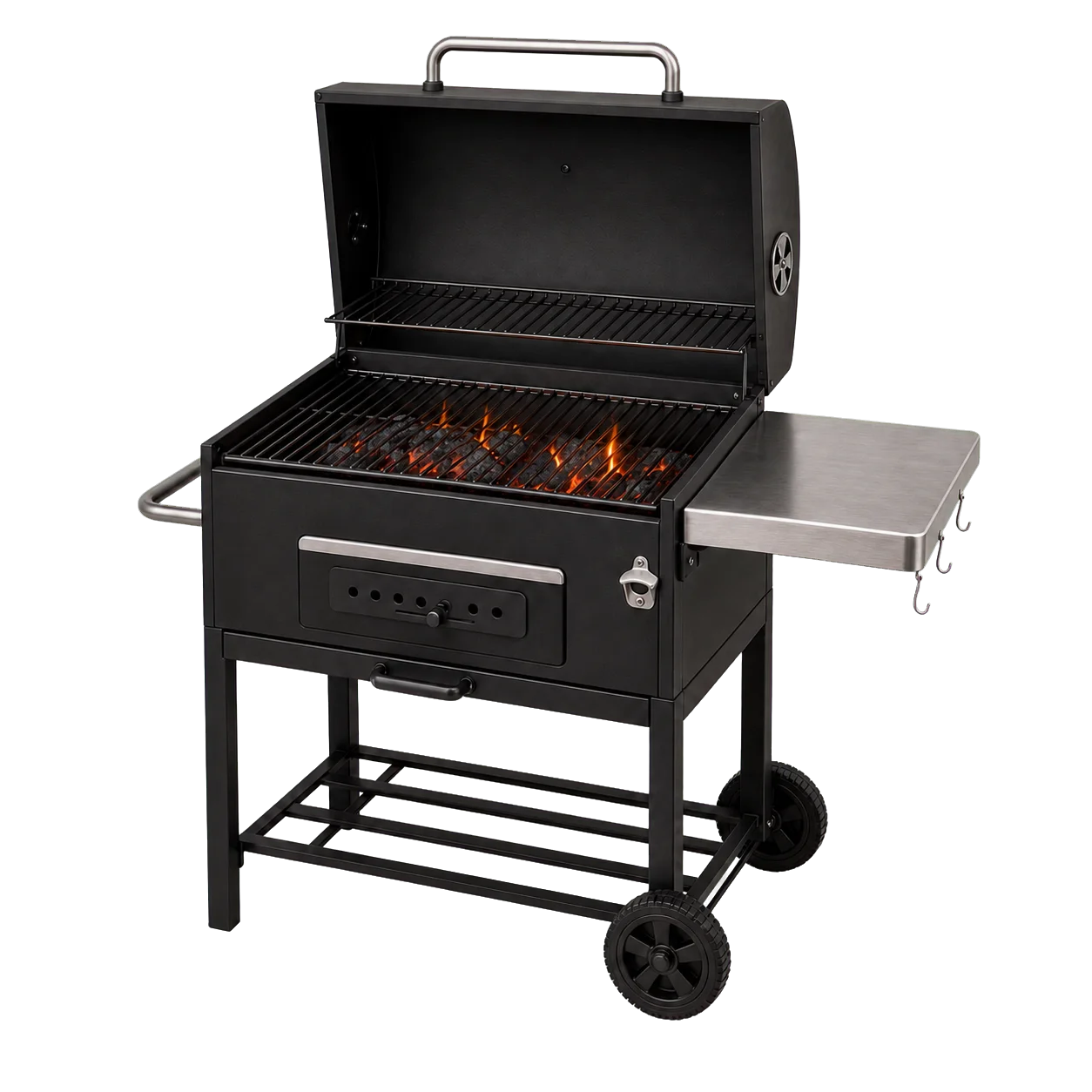
Fuel grate or basket, vents, lid, cooking-grid position and ash collector are listed against the wood, lump-charcoal or briquette setup they serve.
Wholesale Live-Fire Cooking
Each advertised fuel mode is supplied as a complete configuration, with its own fuel specification, support components, airflow, cooking-grid position and cooled residue routine.
Product Focus
Split logs, lump charcoal and briquettes create different fuel-bed depths, flame behavior, refill routes and residue. The product specification therefore identifies the exact components and conditions for each mode, and keeps performance claims tied to the fuel and method actually tested.
Fuel grate or basket, vents, lid, cooking-grid position and ash collector are listed against the wood, lump-charcoal or briquette setup they serve.
Log dimensions or charcoal type, particle range, batch mass, bed depth and refill method are stated separately for each advertised mode.
Temperature, cooking time or batch claims remain linked to the stated fuel, load, grid position, weather and operating method.
Design Details
Wood and charcoal need separate loading, firing, cooking and fully cooled cleaning sequences.
The wood grate, charcoal basket or other supplied support is paired with the declared fuel size, batch and permissible fill range.
Inlet, outlet, lid and refill positions belong to the selected fuel without transferring settings from the other mode.
Usable area, grid elevation, food or cookware mass and tool clearance are specified for each claimed operating configuration.
Residue capacity, complete extinguishment, ash removal and any component changeover are completed before the alternate fuel setup is assembled.
Specifications
Each fuel setup should identify its required components, food load and care routine.
Materials & Finish
Body panels, fuel-bearing parts and food-contact surfaces are declared independently for their actual temperature, load and care duties.
Steel grade, section, joints, coating system and temperature limits are stated, with coated panels excluded from food contact unless specifically supported.
Grade, bar section, weld condition and heat-treatment details are stated for the selected grid with one food-contact status and matching care instructions.
Casting grade, supplied seasoning or coating, supported load and dry-storage routine are declared by component without implying a universal thermal result.
Applications
The relevant configuration follows available fuel, menu load, site rules, residue handling and the operator's ability to manage two distinct routines.
A patio model can offer separate wood and charcoal setups where fuel storage, clearances, guest separation and cooled ash handling are planned.
A transport configuration should include the complete conversion parts, packed fuel-support components, nominated menu and permitted campsite conditions.
A fixed module requires cabinet clearances, ventilation, fuel access, grid load, grease route and ash-service space for each advertised mode.
OEM & Private Label
Private-label work can coordinate grates, vents, grid and instructions around selected wood and charcoal routines.
FAQ
A dual-fuel grill should identify both complete fuel setups and the parts required for each one.
Only where the named component is specified for both fuel batches. Support geometry, airflow, fuel depth and ash capacity are stated separately even when a part is shared.
The declared area excludes handles, frames and unsupported edges, and is tied to the nominated food or cookware load and grid position for the selected fuel mode.
No. A result belongs to the stated fuel specification, batch, cooking load, grid position, weather and operating method.
Selection is based on the actual grade, section, finish, supported load, food-contact declaration and care routine rather than a generic material ranking.
The packing plan assigns each part to its fuel mode and separates clean food-contact components from completely cooled ash-bearing parts.
A clear quotation needs both fuel specifications, complete component setups, menu and load, grid positions, airflow, residue handling, quantity and destination.