Shaft-to-Notch Engagement
Flat width and thickness, round diameter or twisted profile are recorded with notch shape, seating depth, restraint and intended rotation method.
Wholesale Live-Fire Cooking
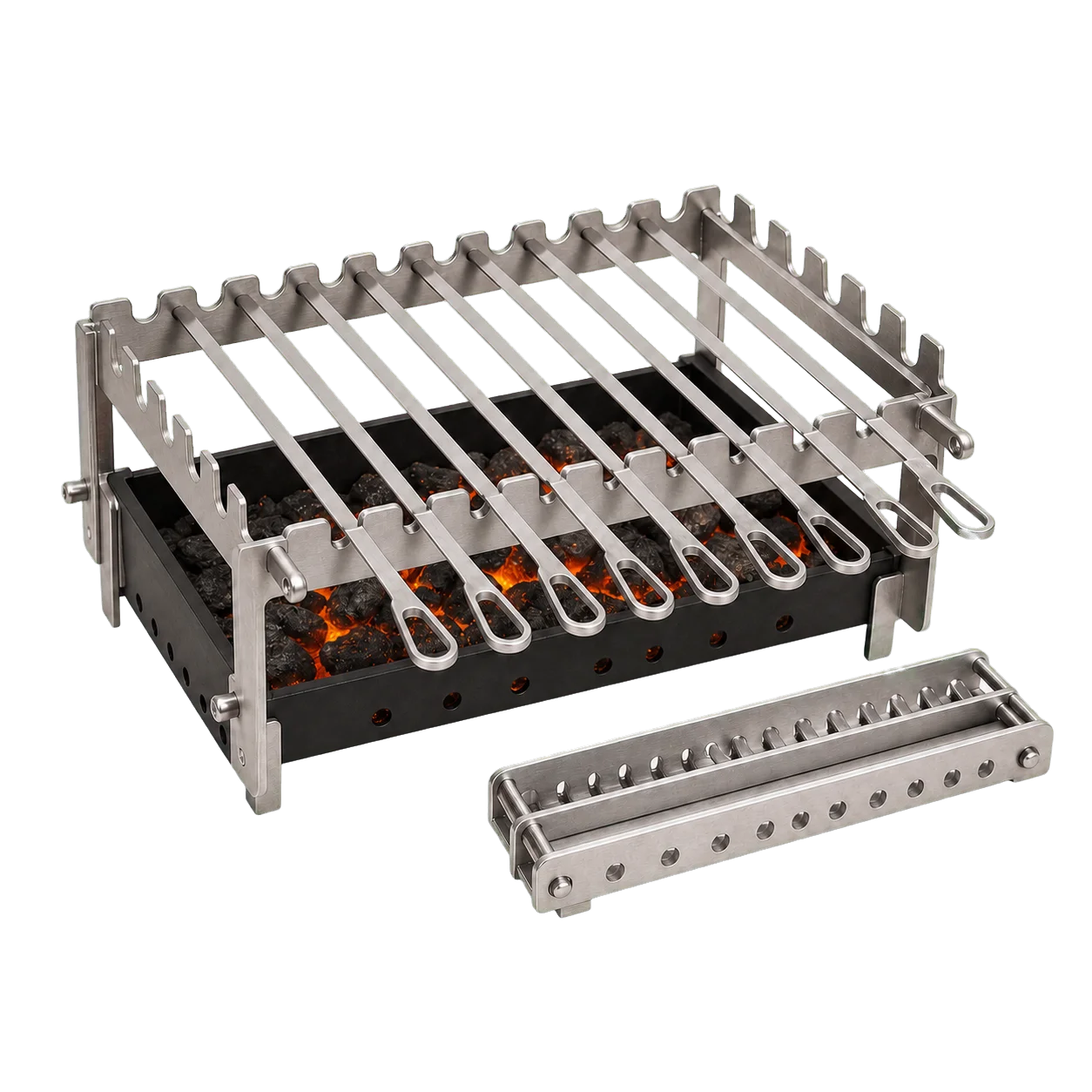
Each rack is specified with a named skewer profile and loaded food envelope, so working capacity reflects secure seating, full rotation and operator access on the selected host.
Product Focus
Empty notches can appear usable even when wide food portions collide, round shafts roll or handles cannot complete a turn. The final layout is therefore checked with the actual shaft, food dimensions and host support through the advertised cooking and removal actions.
Flat width and thickness, round diameter or twisted profile are recorded with notch shape, seating depth, restraint and intended rotation method.
Maximum food width, eccentricity and loaded skewer deflection are checked through a complete turn at the proposed working pitch.
Grip length, rotation path, serving removal, host ledges and fuel zone are documented without implying that handles remain cool.
Design Details
The rack is specified around the same skewers and portions through placement, turning, cooking-tool access and removal from the named host.
The declared shaft profile is checked for insertion, seating depth, lateral movement and retention with the nominated food mass applied.
Adjacent food envelopes, shaft deflection and handles are observed through a complete turn without counting positions that collide or cannot be operated.
Span, ledge contact, restraint and movement are recorded with the full advertised working count in the least favorable documented arrangement.
Operator tools, handle paths and serving removal are separated from the later fully cooled washing, drying and storage sequence.
Specifications
The specification links one shaft and food combination to the rack's working positions, complete load, host seating and operator route.
Materials & Finish
Food-contact shafts, load-bearing frame and hand interfaces receive separate grade, finish, temperature and care records.
Grade, shaft profile and section, point and edge condition, finish, food-contact status, deflection condition and cleaning instructions are stated.
Material, section, joints, notch finish, host load condition and any coating exclusion from food contact are documented for the selected rack.
Material, attachment, cleaning limits, temperature exposure and replacement reference are declared without treating handle position as proof of cool touch.
Applications
The relevant rack follows regional shaft geometry, portion envelope, batch count, turning method and host support rather than nominal notch quantity.
A patio set can be specified around the actual skewer profile, family portions, loaded turning clearance, compatible grill and serving-removal route.
A hospitality layout records portion consistency, verified working count, turning sequence, changeover timing and cleaning capacity for the nominated menu.
A camp set can be specified around the packed host, declared outdoor site, food-safe cleaned storage and separation from fully cooled soot-bearing parts.
OEM & Private Label
Private-label development can coordinate shaft-to-notch engagement, loaded pitch, host support, handle route and cleaned storage around the nominated portions.
FAQ
Working count is documented with the named shaft profile, loaded food envelope, full turning path and host support rather than empty notch quantity.
No. Flat width and thickness, round diameter or twisted geometry must match notch shape, seating depth, restraint and intended rotation method.
Only positions that seat the loaded shaft, clear adjacent food through a full turn and preserve handle access on the named host are counted.
Compatibility is limited to hosts with documented opening, ledges, support span, restraint, heat position and complete loaded path.
The record identifies skewer shafts and any rack surface intended to contact food, including material grade, finish and cleaning instructions.
Washed and dried food-contact parts return to a sleeve or compartment that separates them from completely cooled soot-bearing parts and protects sharp points.
The development record includes shaft profile, food envelope and mass, working count, turning method, host geometry, handle path, food-contact materials, quantity and destination.