Food Geometry, Retention and Offset
Length, diameter, mass distribution, center-of-mass offset and fork or clamp engagement are recorded for the nominated load.
Wholesale Live-Fire Cooking
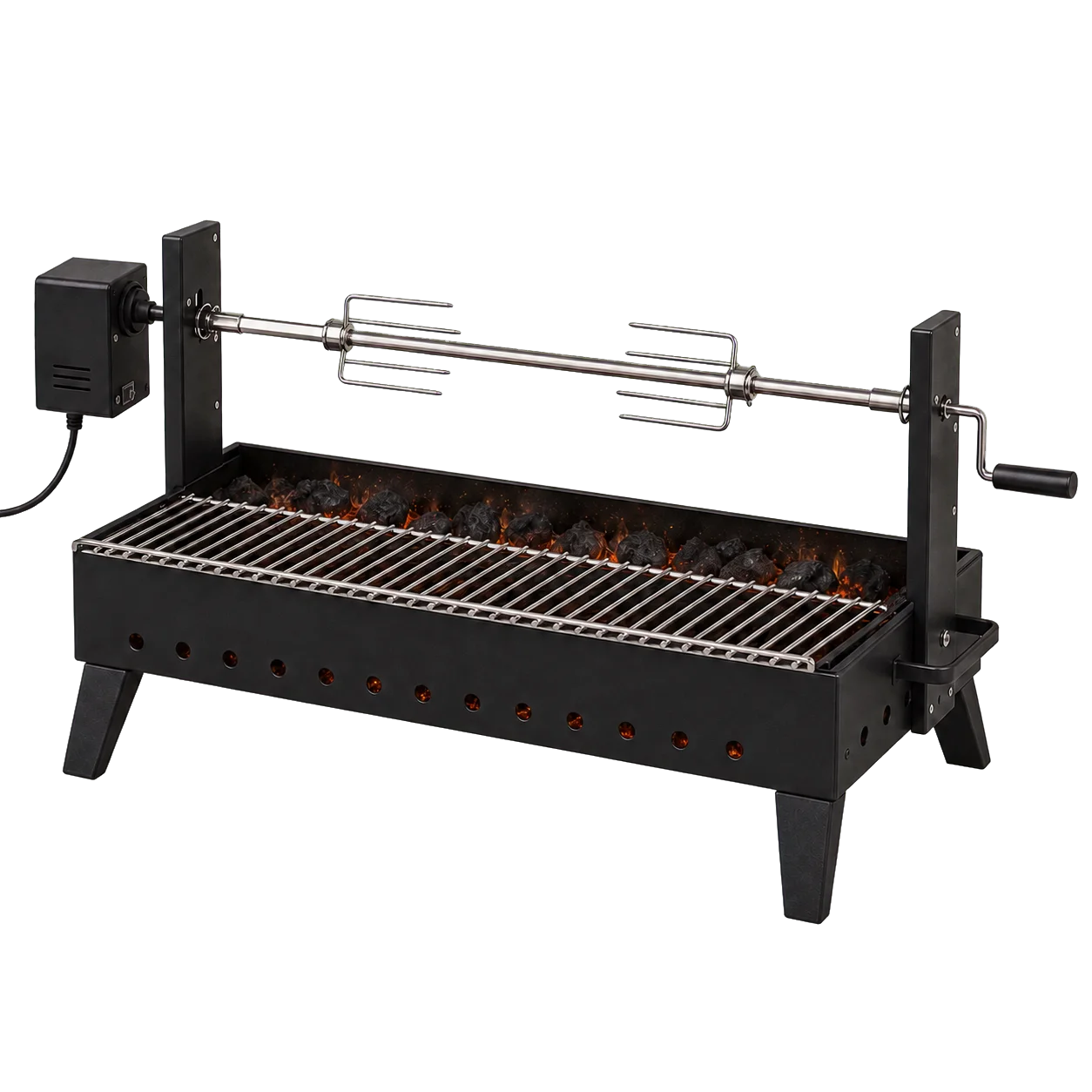
Each rotisserie is specified around a nominated whole cut or poultry load through retention, balancing, shaft support, startup and running torque, drip control and the selected host-grill interface.
Product Focus
Two foods of equal mass can impose different torque and shaft deflection when their centers of mass sit at different distances from the spit. The product record therefore connects actual food geometry and retention to the supported span, alignment, drive condition, host heat boundary and cleaning sequence.
Length, diameter, mass distribution, center-of-mass offset and fork or clamp engagement are recorded for the nominated load.
Working length, bearing or notch positions, loaded runout or deflection and freedom from binding are checked on the named host.
Manual effort or motor torque, speed, duty, abnormal-stop response and destination electrical configuration accompany the drive claim.
Design Details
The operating specification follows the eccentric load from food clamps through the shaft and supports into the crank or motor while the host heat source remains documented.
The nominated food is secured against axial movement and rotation using the supplied components and stated insertion or clamping method.
Alignment, runout, deflection, support movement and binding are recorded through a complete rotation at the least favorable documented load offset.
Startup torque, running condition, speed and the response to a jam, power loss or manual stop are documented for the selected drive.
Fat collection, shielded components, removal order and food-zone cleaning are documented after shutdown and complete cooling.
Specifications
The specification links the nominated food and center-of-mass offset to one spit, support pair, host attachment, drip arrangement and manual or powered drive.
Materials & Finish
Food-contact, structural, bearing and electrical parts receive separate declarations because their duties and service conditions differ.
Material grade, shaft and tine section, surface finish, food-contact status, attachment and cleaning instructions are stated for the nominated load.
Material, section, finish, attachment, alignment condition, temperature exposure and wear criteria are recorded for the named grill.
Materials, coupling interface, torque and duty record, thermal location, controls and model-specific service references are confirmed for the selected drive.
Applications
Application suitability follows the actual cut geometry, service batch, host attachment, drive duty, fat handling and operator separation.
A patio configuration can be specified around the named bird or roast, loaded offset, host grill, support span, drip tray and supervised serving sequence.
A service model records each food load, changeover timing, motor duty, fat-collection capacity, cleaning interval and spare drive references.
An event system requires documented operator and guest zones, power route where applicable, abnormal-stop procedure, hot-fat control and food-zone cleaning capacity.
OEM & Private Label
Private-label development can coordinate food retention, shaft and supports, host attachment, drive response, destination power and drip components around the nominated menu.
FAQ
Capacity is documented for the complete food-retention, shaft-support, drive and host configuration rather than spit length or motor label alone.
The stated load includes food geometry, mass distribution and offset, retention method, shaft span and deflection, support alignment, drive response and host attachment.
A greater center-of-mass offset increases cyclic torque and can increase shaft movement, slipping or binding even when total food mass is unchanged.
The record identifies the spit, forks, clamps and any drip or handling component intended to contact food separately from coated structural supports.
No. Voltage, frequency, plug, controls, documentation and applicable market requirements are confirmed for each destination version.
Compatibility is limited to named hosts with documented attachment, support alignment, shaft span, drive and handle clearance, heat separation and drip route.
The development record includes food geometry and eccentric load, host grill, shaft span, support height, retention, manual or motor drive, power destination, drip handling, quantity and menu.