Usable Area after Service Exclusions
Drain channels, handles, perimeter gaps, tool-rest areas and zones outside the stated temperature range are excluded from the declared food-working surface.
Wholesale Live-Fire Cooking
Each plancha is specified around a nominated menu and service sequence, with working area, loaded temperature behavior, scrape direction and grease capacity stated for the selected heat source.
Product Focus
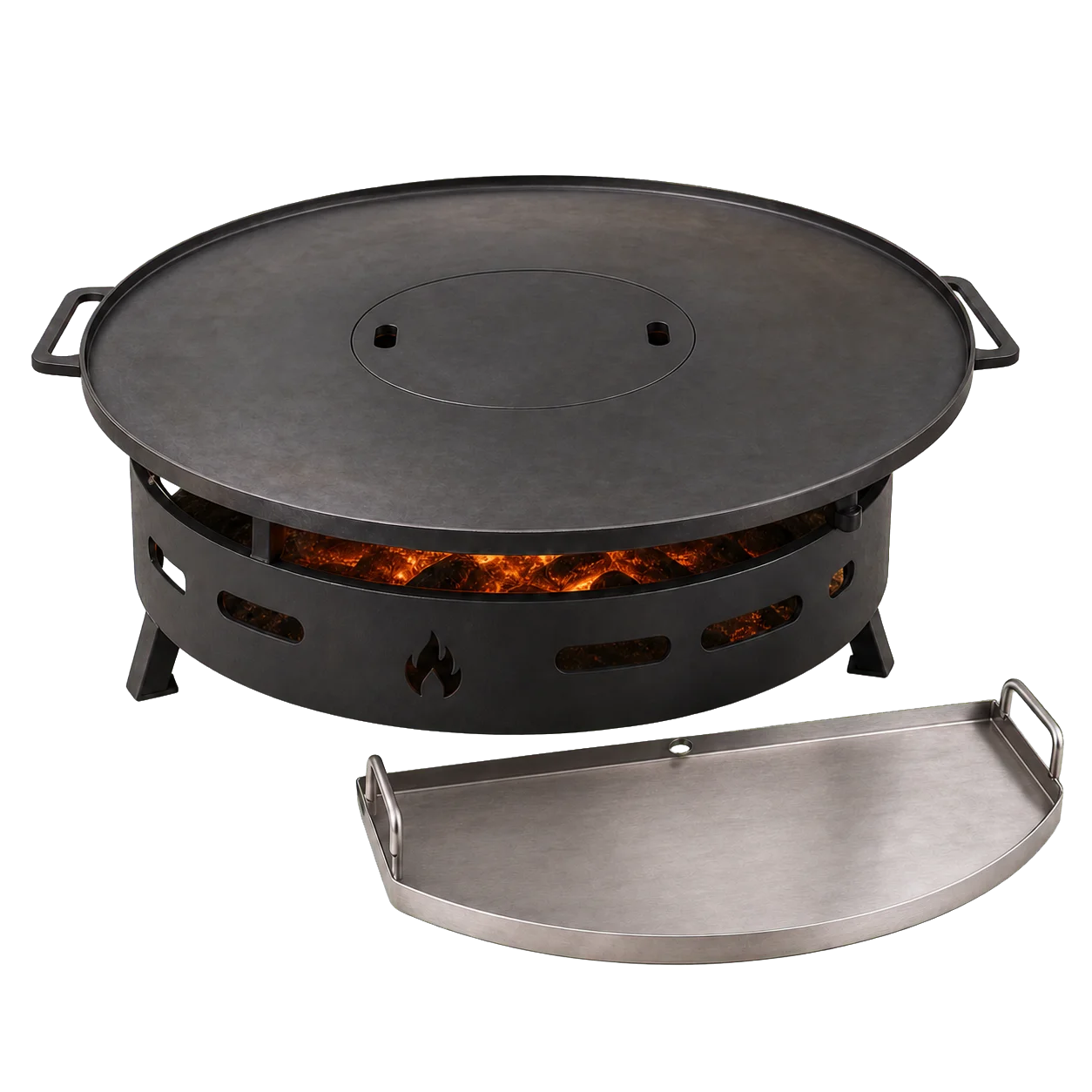
Outer plate dimensions do not show how much food can be cooked, moved and held while grease is removed. The selected plate should be matched to nominated portions, utensils and operating sequence, using a defined temperature grid and the actual host, firing method and collector arrangement.
Drain channels, handles, perimeter gaps, tool-rest areas and zones outside the stated temperature range are excluded from the declared food-working surface.
Measurement locations, heat source, fuel or control setting, preheat condition, food load, time and ambient conditions accompany any zone claim.
Plate slope, hot-state deformation, scrape direction, outlet, collector volume and removal path are specified with the nominated menu residue.
Design Details
The operating specification follows food and grease across the final plate while the host, heat source and support condition remain fixed.
Support contacts, initial flatness, finished mass and hot-state movement are stated with the nominated food and utensil load.
A defined grid states plate temperatures and recovery at stated times before and after the nominated portions are added or moved.
Residue movement should pass from each advertised working zone through the channel or outlet without crossing the operator, guest or fuel-loading route.
Usable collector volume, overflow boundary, handle access and removal path are specified, followed by material-specific plate care after complete cooling.
Specifications
The specification connects nominated portions and service timing to the usable plate, heat-source condition, temperature map and complete grease route.
Materials & Finish
Material selection is stated with grade, thickness, support, finish and test conditions rather than used as a shortcut for heat or corrosion performance.
Steel grade, thickness, working finish, supplied seasoning, support condition, loaded temperature record and dry-storage routine are stated for the selected model.
Casting grade, section, defect and supported-flatness criteria, supplied finish, finished mass and seasoning routine are stated without assuming uniform heat behavior.
Grade, thickness, fabrication, finish, food-contact declaration, loaded temperature behavior and care instructions are stated for the actual plate.
Applications
The relevant plate size and zone layout follow portion geometry, batch timing, operator reach, residue rate and the selected host rather than a generic hospitality label.
A proposed plate should match actual egg, vegetable and protein portions, batch sequence, utensil movement and collector demand during the intended service period.
A supervised setup states guest separation, operator reach, fuel or control access, hot-grease route and the nominated social menu.
A built-in plancha requires counter support, heat separation, ventilation, collector access and removal space for the selected plate and host.
OEM & Private Label
Private-label work can coordinate host form, nominated menu, heat profile and grease route before confirming support pieces and care guidance.
FAQ
Plancha value depends on the declared working surface, measured heat behavior and grease route under a real menu load, not on outer plate size alone.
The usable area excludes handles, drain channels, edge gaps, unsupported zones and any surface outside the stated service temperature range.
The record should state the host, heat source, preheat condition, measurement grid, food load, timing, ambient conditions and recovery behavior.
The actual grade, thickness, support, finish, food-contact declaration, loaded temperature data, finished mass and care routine provide the comparison.
The specification should identify plate slope, scrape direction, outlet or channel geometry, usable collector volume, fill limit and removal route.
Only named hosts should be listed, and each one needs its own support condition, heat-source position, working-area limits and service-clearance checks.
A clear quotation needs menu type, portion size, batch timing, selected host, heat source, plate material, grease routine, accessory set, quantity and destination.