Opening and Support-Ledge Drawing
Length, width, corner geometry, ledge contact, insertion depth and removal clearance are stated for the named table model.
Wholesale Live-Fire Cooking
Each insert is matched to a named table interface as a loaded heat-producing module, including rim contact, insertion depth, underside conditions and neighboring components.
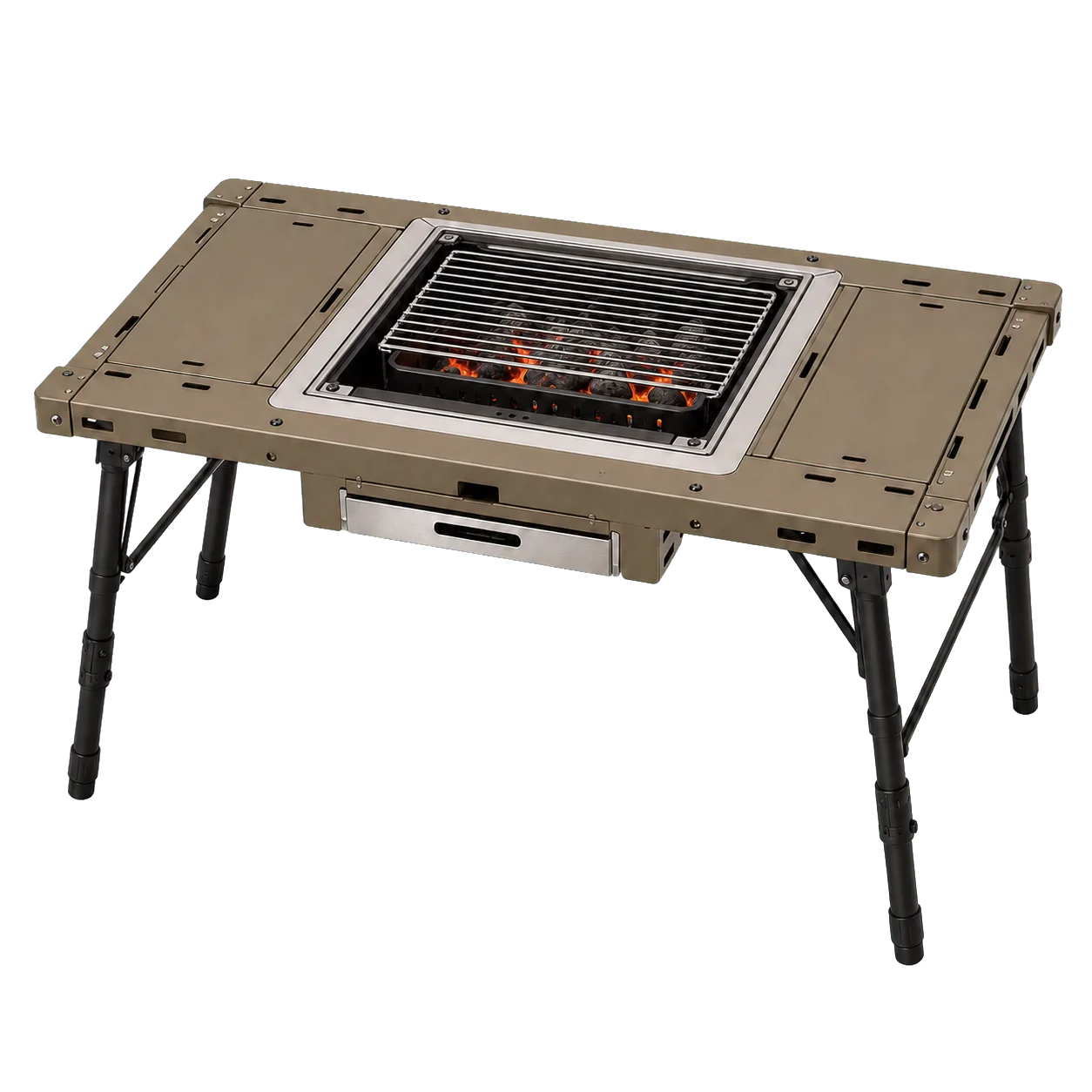
Product Focus
Table openings that look similar can differ in corner radius, ledge width, insertion depth, frame material and adjacent-module spacing. Compatibility applies only to the measured host and the complete grill configuration used for dimensional, load and temperature checks.
Length, width, corner geometry, ledge contact, insertion depth and removal clearance are stated for the named table model.
The support path includes grill body, permitted fuel, cooking components and nominated food load in place.
Measurement locations, host material, fuel batch, operating duration and neighboring module arrangement accompany any heat-separation claim.
Design Details
The integration specification uses the final table, insert, fuel arrangement and adjacent modules rather than an isolated rectangular envelope.
Body dimensions, corners, protrusions and insertion path are checked against the measured host without forcing or relying on nominal module language.
Contact width, restraint and table-frame response are specified with the full module, maximum stated fuel and nominated cooking load.
Temperatures at the underside, ledge and adjacent components are stated for the host material, fuel batch, duration and ventilation condition.
Handle access, finished mass, residue tray removal and contact-surface inspection apply after extinguishment and complete cooling.
Specifications
The host interface drawing, adjacent modules, usable food area and underside clearance determine compatibility.
Materials & Finish
Food-contact, combustion, load-bearing and table-contact components receive separate declarations and temperature-check conditions.
Material grade, section, weld or edge condition, finish, food-contact status and care instructions are stated for the selected surface.
Material, section, joints, finish limits and maximum stated fuel and cooking load are listed for the complete insert.
Material, thickness, contact geometry and host-specific temperature evidence are declared without treating the presence of a shield as proof of table protection.
Applications
The insert is relevant where the table interface, complete load, fuel routine and thermal boundary can be specified together.
A matched insert should state the exact folding table, ground condition, complete module load and cooled removal route used at camp.
A proposed arrangement lists neighboring trays, burners or worktops, handle and vent clearances, and temperature measurement at their closest points.
A buyer-owned interface standard can coordinate tables and inserts where drawing revision, load path and host material remain consistent across the range.
OEM & Private Label
Private-label work can coordinate the measured interface, complete load, cooking area, thermal test configuration and adjacent components.
FAQ
Compatibility is established through the measured interface and stated heat-separation condition, not through the IGT-style label alone.
No. Opening dimensions, corner geometry, ledge contact, insertion depth, frame material and adjacent structures vary by brand, model and revision.
The compatibility drawing includes opening length and width, corners, protrusions, insertion depth, support-ledge contact, restraint and cooled removal clearance.
Temperatures are measured at stated underside, ledge and adjacent-module locations using the named host material, fuel batch, load, duration and ventilation condition.
Only the stated arrangement is covered, including the closest handle, vent, hot-zone and surface-temperature clearances.
After extinguishment and complete cooling, the specification covers finished mass, handle access, lift path, residue-tray service and inspection of table-contact surfaces.
A clear quotation needs host drawings or sample, host material, complete module load, fuel, food area, adjacent arrangement, thermal conditions, quantity and destination.