Host Rim and Seating Geometry
Internal and external rim dimensions, ledge width, support points and interference with lids or accessories define the compatible host.
Wholesale Live-Fire Cooking
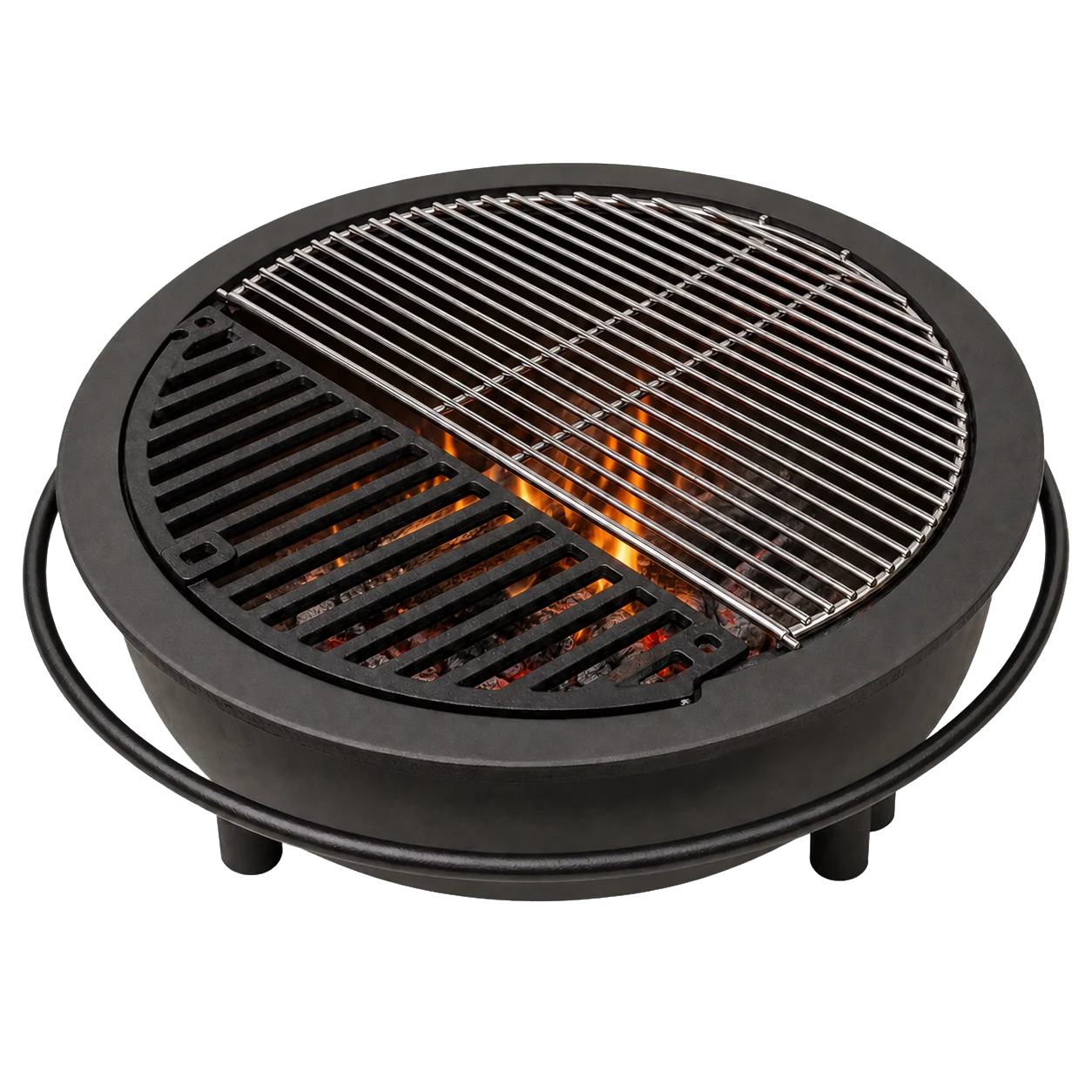
Each grate is supplied as a host-matched component with measured seating geometry, a declared food-contact area and a stated load above the selected fuel bed.
Product Focus
Two fire pits with the same nominal diameter can use different rim profiles, ledges and support points. A suitable grate starts with the named host, nominated food or cookware load, fuel-bed position and cooled removal route.
Internal and external rim dimensions, ledge width, support points and interference with lids or accessories define the compatible host.
The declared working area excludes handles, outer frames and unsupported sections, and identifies whether food or cookware occupies each surface.
Grate height, fuel depth, refill access and planned lifting tools are set for the selected host configuration.
Design Details
The specification follows the complete load path from the host rim through the grate frame and working surface to the nominated food or cookware.
Contact length, ledge width, restraint and permitted movement are tied to the named fire-pit model rather than inferred from nominal diameter.
Frame and bars are sized around the nominated food or cookware mass in its least favorable stated position.
Bar or plate material, grade, finish and food-contact status are stated separately from coated frames, handles and supports.
Lift points, tool access, finished mass and the material-specific cleaning and dry-storage routine apply after complete cooling.
Specifications
A complete specification connects the named fire pit, exact seating interface, nominated menu and load, fuel-bed clearance and handling method.
Materials & Finish
Material declarations separate components that contact food from those carrying load or providing cooled handling.
Grade, bar section, weld condition, surface finish, food-contact declaration and care instructions are stated for the selected grid.
Casting grade, supported geometry, supplied seasoning or coating, finished mass and drying requirements are stated without implying a universal heat result.
Steel grade, section, joints and finish limits are stated, with coated parts excluded from food contact unless specific evidence supports that use.
Applications
A suitable application starts with a named host, menu, supported load, operator route and local live-fire restrictions.
A grate can add a cooking configuration where the host structure, fuel arrangement, clearances and food-contact surfaces support it.
A removable grate should be paired with the packed host, nominated cookware or food load, cooled residue protection and permitted outdoor site.
An attended live-fire station can specify menu load, tool reach, guest separation, removal method and cleaning capacity.
OEM & Private Label
Private-label work can coordinate rim fit, food area, handles and packing with the host range.
FAQ
Compatibility depends on the host interface, supported load, declared food surface and fire clearance rather than nominal diameter alone.
No. Rim profile, ledge, opening, restraint and support points can differ even at the same nominal diameter.
Usable area excludes handles, outer frames and sections that do not support the nominated food or cookware load.
The selected grade, section, finish and test record define performance. Cast iron also requires a declared seasoning and dry-storage routine; stainless care depends on its actual grade and surface finish.
Only when the named vessel, filled mass, position, grate span and host support are included in the stated load condition.
Painted components are excluded from food contact unless the exact coating and intended temperature have specific supporting evidence.
Host-fit checks include rim geometry, clearance envelope, usable area and delivery details tied to this specific station configuration.