Vessel Bail, Hook and Filled Mass
Bail opening, section, attachment strength, hook engagement, empty pot mass and maximum contents are stated as one suspension interface.
Wholesale Live-Fire Cooking
Each tripod is specified as a suspended-load system with a named filled vessel, stated ground and leg spread, stated suspension hardware and a defined lateral-movement boundary.
Product Focus
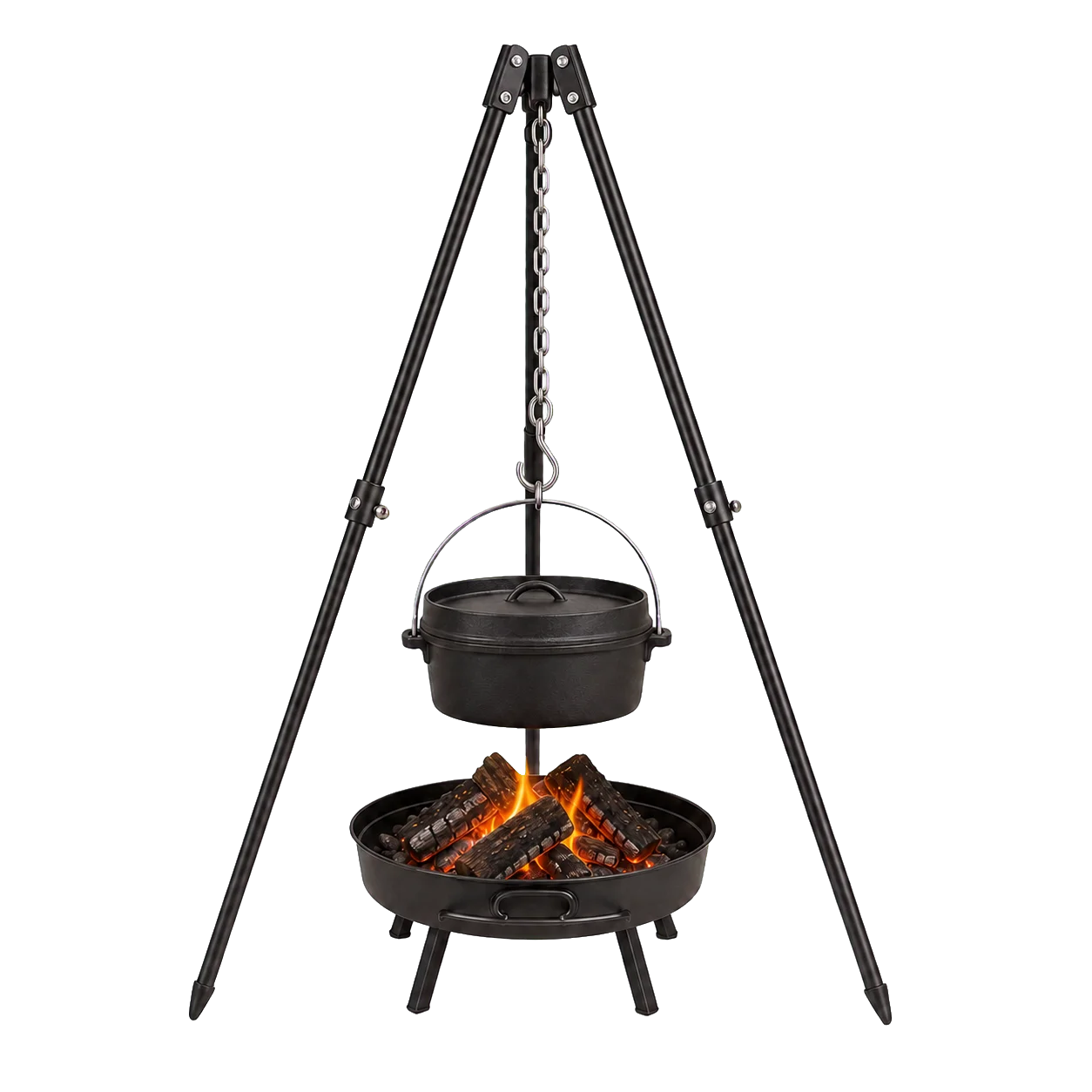
An empty tripod does not reproduce the leg reactions created by a filled pot that is stirred, raised or displaced. The complete assembly therefore starts with the selected vessel, contents, suspension height, footprint and ground condition, including the operator actions that can start a swing.
Bail opening, section, attachment strength, hook engagement, empty pot mass and maximum contents are stated as one suspension interface.
Leg length, spread, foot contact, pole angle and the fixed, chained or detachable apex connection are stated for the ground condition.
Chain travel, retention, lift method, vessel displacement and clear area around fire, legs and operator accompany the working-height claim.
Design Details
The load path is traced from the filled pot through bail, hook, chain and apex into three legs and their declared ground contacts.
Foot penetration, slip, rocking, leg spread and fire-area clearance are stated on the firm non-combustible surface.
Pole ends, joint, chain or connector are specified with the vertical vessel load and the stated lateral displacement condition.
Link engagement, hook orientation, travel and adjustment action are checked with the named filled vessel at each advertised height.
The permitted movement envelope includes pot diameter, handles, fire, tripod legs, adjustment route and serving position without implying hot-touch safety.
Specifications
The specification connects the filled vessel and suspension action to one leg footprint, apex configuration, ground condition and fire-area layout.
Materials & Finish
Each part of the suspended-load path receives its own material, section, joint, wear and care declaration.
Steel grade, pole section, end condition, joint method, coating limits and dry-storage routine are stated for the selected geometry and load.
Grade, section, fabrication and surface care are declared without treating stainless steel as proof of lower mass, greater load or maintenance-free use.
Material, dimensions, engagement, wear inspection and replacement references are confirmed for the named vessel bail and filled-load condition.
Applications
Tripod selection follows the filled vessel, packed pole length, ground condition, permitted fire area and supervised movement envelope.
A longer pole set should state the exact kettle or stew pot, maximum meal load, packed vehicle space and declared campsite footprint.
A bushcraft configuration states local fire permission, ground and fuel area, vessel and chain handling, participant separation and extinguishment routine.
A display setup states filled load, adjustment responsibility, swing boundary, guest separation and hot-equipment control rather than relying on visual presentation.
OEM & Private Label
Private-label work can coordinate vessel geometry, support spacing, ground condition and carry strategy before finalizing kit composition and operation instructions.
FAQ
Capacity belongs to a complete tripod, named filled vessel, stated spread, suspension height, ground condition and movement boundary.
The specification uses the complete pole set, apex, chain and hook with the named vessel and maximum contents at the stated spread, height, ground and lateral-displacement condition.
No. Bail opening, section, attachment strength and orientation must match the selected hook engagement and stated filled mass.
The site envelope includes the full leg footprint, foot condition, fire area, permitted vessel swing, adjustment route and operator clearance rather than folded pole length.
Only where the chain-retention system, nominated load, adjustment sequence and specified hot-handling tools support that action.
No. Finished mass depends on grade, diameter, wall or solid section, leg length, apex and joint construction.
A clear quotation needs vessel and bail, empty and filled mass, working heights, leg spread and ground, apex type, chain and hook, movement boundary, folded target, quantity and destination.