Casting and Defect Acceptance
Material grade, section range and limits for cracks, harmful porosity, flash, sharp edges and distortion are stated for the selected part.
Wholesale Live-Fire Cooking
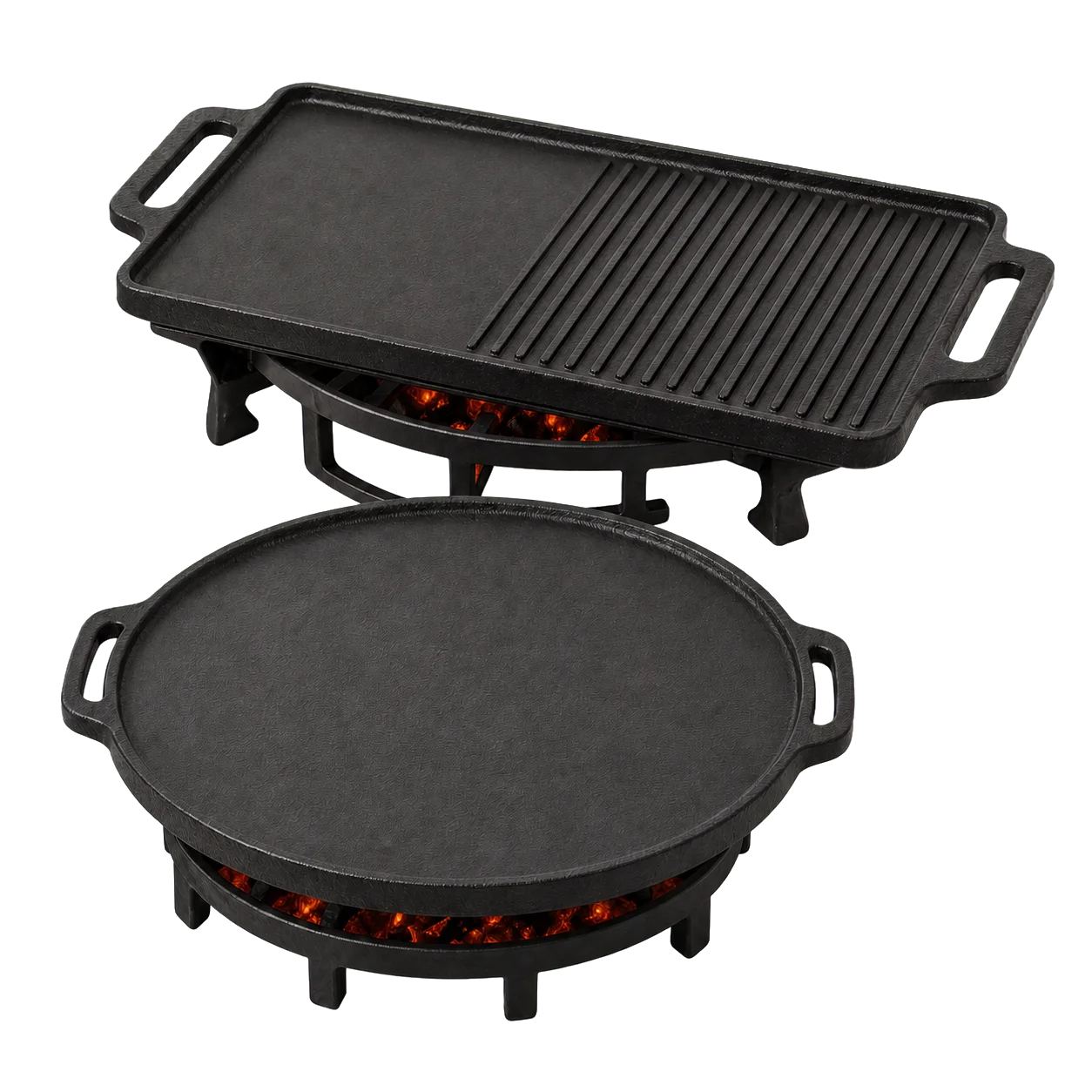
Each casting is specified on its named support, with defect limits, rocking or gap criteria, food-contact faces, grease orientation and cooled lifting method stated for the finished plate.
Product Focus
A heavy casting can still rock, bridge an unsupported span or distort at the handle and drain features. Acceptance therefore uses the final host contact points and a defined measurement method, while food-face finish, supplied seasoning and finished mass are stated separately.
Material grade, section range and limits for cracks, harmful porosity, flash, sharp edges and distortion are stated for the selected part.
Reference points, host contact, measurement locations, permitted rocking or gap and plate orientation accompany the acceptance result.
Smooth, ribbed, channelled or reversible faces are identified with their finish, seasoning, drain orientation and cooled handling method.
Design Details
The finished component is specified from visual and dimensional acceptance to host seating, food-face preparation and removal at its actual mass.
Specified inspection covers cracks, porosity relevant to function, incomplete fill, flash, sharp edges and distortion before seasoning or coating can obscure the surface.
The plate is seated at stated contact points and checked by the stated rocking, gap or profile method in every advertised orientation.
Machining, grinding, texture, channels, supplied seasoning or coating and food-contact status are stated for each working face.
Handle envelope, grip or tool method, lift balance, cooled removal path and dry-storage protection are specified for the completed casting.
Specifications
The specification connects casting quality and food-face finish to one support geometry, nominated menu load and cooled removal routine.
Materials & Finish
Base casting, working surfaces and any separate lift components are declared by their actual manufacturing and service conditions.
Casting grade, chemistry or applicable material reference, section range, defect criteria and supplied corrosion protection are stated for the selected part.
The actual finish, roughness or texture where specified, food-contact declaration, supplied seasoning and ongoing care are stated for each advertised face.
Handle casting condition, separate hardware material, attachment, finished-mass balance and cooled lift method are stated without implying hot handling.
Applications
Application suitability follows the actual support, finished mass, menu load, handling route and seasoning routine rather than plate mass alone.
A larger casting should state the exact frame contacts, supported span, menu load, drain orientation and service-removal space.
A removable plate is offered only for hosts whose rails, stops, heat position and load path match the stated casting orientation.
A high-mass griddle suits programs with planned transport capacity, cooled lifting, impact protection and dry storage for the complete set.
OEM & Private Label
Private-label work can coordinate casting specification, host contact, food-face finish, grease orientation and cooled handling around the named support and menu.
FAQ
Casting acceptance, working flatness and compatibility are defined on the named support with the finished plate in its advertised orientation.
The relevant requirement is a stated rocking, gap or profile limit measured by a defined method on the stated host support, not an undefined claim of perfect flatness.
Only the supplied finish for the ordered model is covered. The food-face instructions also state initial cleaning, drying, seasoning renewal and storage care.
Compatibility may be declared for multiple named hosts only when contact points, restraint, heat position, load path, orientation and removal clearance are stated for each one.
Casting distortion, flash, mismatched contact geometry, debris, unsupported span or host-frame variation can contribute; acceptance checks the plate and named support together.
The specification identifies working orientation, slope or channel geometry, outlet or edge, collector arrangement and the plate condition under the nominated load.
A clear quotation needs measured host geometry, working-flatness method, load spread, finish condition, handle position and destination scope.