Lowest, Highest and Maximum-Leverage Positions
Each advertised position sets grate extension, nominated load placement, guide movement and the resulting limit rather than relying on one general rating.
Wholesale Live-Fire Cooking
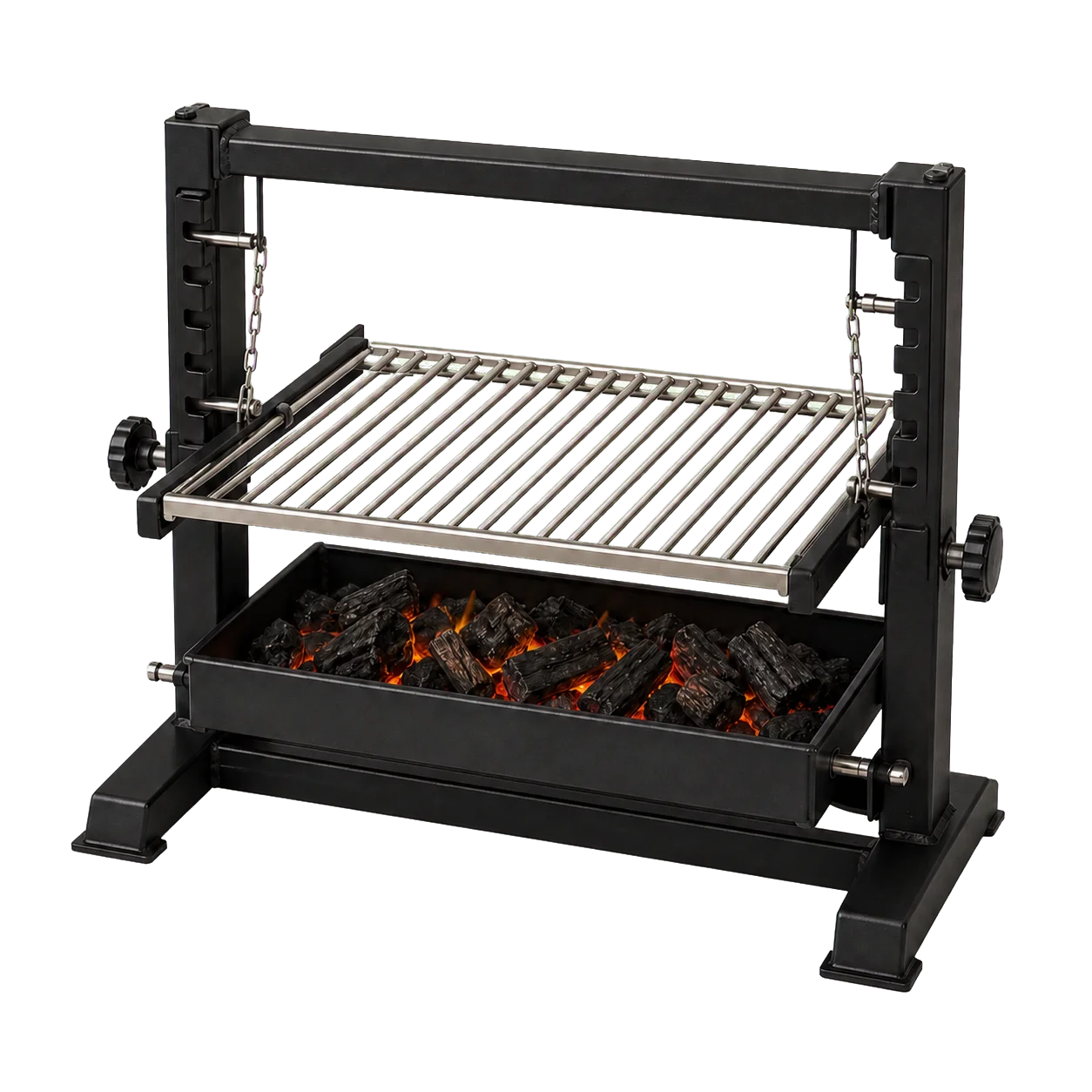
Each adjustable grate is specified as a complete loaded mechanism, with its host connection, working heights, retention method and operator action defined by position.
Product Focus
Raising or extending a loaded grate changes leverage on the guide, mount and locking components. A reliable specification covers the lowest, highest and least favorable advertised positions with the nominated food or cookware mass and actual adjustment action.
Each advertised position sets grate extension, nominated load placement, guide movement and the resulting limit rather than relying on one general rating.
Pins, indexed teeth, collars or another stated device are described by engagement geometry, operating sequence and inspection condition.
Handle, release and tool paths are specified against the food load, flame envelope and host without implying a cool-touch surface.
Design Details
The mechanism specification follows force from the food surface through the grate support, guide and locking device into the named host or ground frame.
Attachment geometry, restraint and support condition are tied to the grate position that produces the greatest applied moment.
Clearance, play, binding and permanent displacement are considered only across the positions offered for loaded cooking.
The stated pin, tooth, collar or lock must fully engage with the nominated centered and off-center load at each advertised height.
The operating sequence identifies whether unloading is required, which handle or tool is used and where hands and food move relative to flame and hot components.
Specifications
The complete specification links the named host, usable grate area, guide geometry and adjustment method to a load limit for every advertised cooking position.
Materials & Finish
Cooking, structural and wear interfaces receive separate declarations because one material description cannot substantiate the complete mechanism.
Grade, section, weld condition, finish and food-contact status are stated for the selected cooking components.
Material grade, section, joints, coating limits and the applicable position-load condition are stated for the structural path.
Material, fit, engagement surface, inspection condition and replacement reference are confirmed for the selected locking mechanism.
Applications
Height adjustment is a mechanical operating option within a named outdoor setup, not evidence of temperature control by itself.
An adjustable system can serve a specific host, food load and clear operator route through its supported positions.
A camp configuration depends on the ground or frame connection, cookware mass, extension and permitted site conditions.
A managed station can specify repeatable working positions, load changes, adjustment responsibility, inspection intervals and surrounding clearance.
OEM & Private Label
Private-label work can align host connection, load positions and locking behavior with the intended menu before defining controls, load limits and buyer guidance.
FAQ
Usable travel, load capacity and adjustment method belong to the complete host-mounted mechanism and are specified by working position.
Not necessarily. Each advertised height and extension carries its own load condition because leverage on the guide, lock and host connection changes with position.
The selected retention method is checked by engagement geometry, supported load, operating action, inspection condition and replacement route rather than by mechanism name alone.
Loaded adjustment applies only where the specified handle or tool, locking sequence, nominated load and operator route support that action.
Usable travel includes only positions that fully engage the stated lock and carry the stated load; free movement of an empty mechanism is not counted as a cooking position.
No. Attachment geometry, support structure, grate offset and applied load must match the named host or ground frame.
A clear quotation needs host connection, working heights and extensions, lock type, adjustment sequence, centered and off-center loads, food surface, quantity and destination.